In which a group of graying eternal amateurs discuss their passions, interests and obsessions, among them: movies, art, politics, evolutionary biology, taxes, writing, computers, these kids these days, and lousy educations.

E-Mail Donald
Demographer, recovering sociologist, and arts buff

E-Mail Fenster
College administrator and arts buff

E-Mail Francis
Architectural historian and arts buff

E-Mail Friedrich
Entrepreneur and arts buff
E-Mail Michael
Media flunky and arts buff


We assume it's OK to quote emailers by name.


Try Advanced Search


  1. Another Technical Note
  2. La Ligne Maginot
  3. Actress Notes
  4. Technical Day
  5. Peripheral Explanation
  6. More Immigration Links
  7. Another Graphic Detournement
  8. Peripheral Artists (5): Mikhail Vrubel
  9. Illegal Update


CultureBlogs
• Sasha Castel
• AC Douglas
• Out of Lascaux
• The Ambler
• PhilosoBlog
• Modern Art Notes
• Cranky Professor
• Mike Snider on Poetry
• Silliman on Poetry
• Felix Salmon
• Gregdotorg
• BookSlut
• Polly Frost
• Polly and Ray's Forum
• Cronaca
• Plep
• Stumbling Tongue
• Brian's Culture Blog
• Banana Oil
• Scourge of Modernism
• Visible Darkness
• Seablogger
• Thomas Hobbs
• Blog Lodge
• Leibman Theory
• Goliard Dream
•
Third Level Digression
• Here Inside
• My Stupid Dog
• W.J. Duquette


Politics, Education, and Economics Blogs
• Andrew Sullivan
• The Corner at National Review
• Steve Sailer
• Samizdata
• Junius
• Joanne Jacobs
• CalPundit
• Natalie Solent
• A Libertarian Parent in the Countryside
• Rational Parenting
• Public Interest.co.uk
• Colby Cosh
• View from the Right
• Pejman Pundit
• Spleenville
• God of the Machine
• One Good Turn
• CinderellaBloggerfella
• Liberty Log
• Daily Pundit
• InstaPundit
• MindFloss
• Catallaxy Files
• Greatest Jeneration
• Glenn Frazier
• Jane Galt
• Jim Miller
• Limbic Nutrition
• Innocents Abroad
• Chicago Boyz
• James Lileks
• Cybrarian at Large
• Hello Bloggy!
• Setting the World to Rights
• Travelling Shoes


Miscellaneous
• Redwood Dragon
• IMAO
• The Invisible Hand
• ScrappleFace
• Daze Reader
• Lynn Sislo
• The Fat Guy
• Jon Walz

Links


Our Last 50 Referrers


« Free Reads -- Bachini on Modernist Architecture | Main | Digital Dreams »

December 02, 2002

Rewriting (Art) History

Michael

As you know, I’m a bit critical of the standard-issue histories of Modern Art that we were force-fed back in the 1970s. Just to see if they were still peddling the same old stories, I picked up, essentially at random, “Modern Art 1851-1929” by Richard R. Brettell, which is part of the Oxford History of Art series. I must say, I was pleasantly impressed: the art historical community, if accurately represented by Dr. Brettell (a professor at the University of Texas), has managed to overthrow a few idols since I checked in last.

The first, and most immediately shocking change I noted was the shift away from a rigidly Franco-centric view of Modern Art. While there are still plenty of the French (and German and Spanish) artists you would expect to find in the book, just thumbing through the illustrations lets you see work by artists from Britain, Poland, Sweden, Romania, Russia, Czechoslovakia, Finland and Canada. I mean, when’s the last time you saw a brief history of modern art that even mentioned Canada? And he admits that his account is probably still too oriented toward Western Europe:

The recent opening-up of Russia and central Europe has coincided with a massive attempt to redescribe modernism in western Europe, the Americas, and Australia. This has resulted in a data-glut of proportions for which all of us are unprepared. Few historians of modern art, trained in the West during the last generation, even know the names of the major figures in eastern European or Latin American modernism, in either the nineteenth or the twentieth century. And the national histories of art kept so faithfully by historians and museum curators in Russia and eastern Europe have not been linked to the truly international and cosmopolitan art history to which they belong.

The second change was the shift away from the parade of “-isms” (ah, you know: “Realism begat Impressionism which begat Post-Impressionism which begat Synthetism which begat the Nabis…etc., etc.”) We must still be in a transitional period regarding the parade of “-isms” because Prof. Brettell was forced to traverse them at a quick march at the start of the book; you gotta congratulate him, though, he actually does a reasonable job on 18 separate
“-isms” in a mere 31 pages.


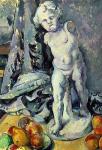
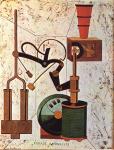
Unmediated Cezanne vs. Image/Modernist Picabia

However, he then moves on to his preferred two-part classification: artists who dreamed up their own images—in many cases before the motif—which he calls “unmediated modernism,” and artists who primarily juggled existing images, which he calls “image/modernism.” (No, I have no idea why he uses the slash between image and modernism.) This may seem like a matter of “you say tomato, I say tomahto” but he uses these categories rather slyly to dethrone the myth that art was on a straight runway from Impressionism to Cubism, and then achieved liftoff into the Empyrean regions of Abstraction. According to the good professor, analytic Cubism is an “unmediated modernist” phenomenon…

…in looking at analytic Cubist paintings and in reading the early sources one is struck over and over again that Cubist painters worked en face du motif just like the Impressionists and many Post-Impressionist artists…In spite of all the early criticism that situates Cubism as the antithesis of the then fashionable Impressionism, a good deal of the theory of Cubism flows easily from that of the earlier artists. The Impressionists, several of whom (Monet, Degas, and Renoir) were alive when Picasso and Braque carried out their revolutionary experiments, were equally fascinated both with time and with a motion-filled idea of the world.

…while abstraction is essentially on the other side of the fence in the image/modernism pasture:

It has long been known that a good deal of the theory of abstraction in northern Europe and the Americas developed from forms of transnational mysticism, many of which were textually based. Rendering visible sounds, spirits, cosmic forces, and other invisible forms was a principal task of a particularly vital form of cosmopolitan modernism in the first two decades of the twentieth century. Although these advances in pictorial practice were heralded as completely revolutionary in the years following their appearance, recent scholarship and museological practice have taught us that abstraction grew out of many ideas [read Theosophy] powerfully associated with Symbolism and other forms of occult image/modernism.

Which should not be taken as a criticism of image/modernism—even though the good Professor can’t help having a little fun at the expense of the well-to-do-cultists who launched abstraction—because that side of the fence is really where Brettell’s heart is. He returns repeatedly—and usually insightfully—to photography and mechanical image replication as the prime driver of Modernism, whether it pushed Modern artists into the moralistic conservatism of unmediated modernism or into the orgiastic free love of image/modernism:

When an artist was at play in a world of images, the possibilities were so great by the middle and later nineteenth century that one could easily claim that there was more ‘territory’ for the artist in the image world than in the actual world. Artists confined to the confrontational strategy of unmediated modernism were hampered to a considerably greater degree than artists who combed guidebooks, illustrated histories of art, exhibitions, scientific illustrations, X-rays, posters, popular prints and the like for inspiration.

This leads to the third change I noticed, which is the fact that professor Brettel with his two-part schema manages to incorporate a great deal more activity into the Modernist enterprise than, say, Alfred Barr ever deigned to notice. This is a book that not only manages to situate Joaquin Sorolla, John Singer Sargent and Anders Zorn in the modernist context (in case you’re wondering, they’re unmediated modernists, surface fetishist division), but even digests “The Pre-Raphaelite Brotherhood” (!)

When we think of the Pre-Raphaelites, with historicity built into their very name, it is impossible to conceive of their existence before the art museum, the concept of the history of art, easy travel, reproductions, and art criticism…[the Pre-Raphaelites] project of ‘revival’ was precisely in sync with that of the independent Arundel Society, a group who promoted Italian religious art of the early and high Renaissance by commissioning elaborate chromolithographic reproductions of works for schools, churches, and suitably pious members of the public. Charles Eastlake, director of the National Gallery in London, directed his purchasing powers toward the same period in the history of painting, and by the 1870s the British national collections of Italian Renaissance painting were superior to those of any European country except Italy itself…At the same time, London supplanted Paris as the center for the old master market, with dealers and auction houses increasingly selling major works of Italian art, many of which were thus accessible to the artists, albeit temporarily. In 1857, less than a decade after the creation of the Brotherhood, the largest and most important temporary exhibition of old master painting ever held in Europe was mounted in Manchester, and British and European artists flocked to see it…[T]he modern scholar has a great deal of difficulty in analyzing the sources of Pre-Raphaelite art, not simply because the artists disguised their sources, but because there were so many of them, both visual and literary…

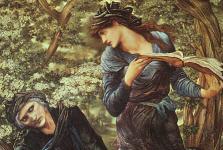
Hey, anybody who demonstrates how Burne-Jones connects to modern art (and vice versa) gets a round of applause from me.


E. Burne-Jones, The Beguiling of Merlin, 1874 (Detail)
Mainstream Modernism?

Of course, Prof. Brettell ends his account in 1929 with the creation of the Museum of Modern Art—and that’s an idol that still needs overthrowing. Anyway, let’s hear a good Blowhardy for Professor Brettell!

Cheers,

Friedrich

posted by Friedrich at December 2, 2002


Comments

Let's give him a Blowhardy indeed. Sounds like a big improvement in openness over what we were subjected to.

Now, how about a history of art from 1850 to the present that views modernism as just one of the many things that was going on, and not the whole story? I don't know of one such. Do you?

Posted by: Michael Blowhard on December 3, 2002 01:58 AM


Post a comment
Name:


Email Address:


URL:


Comments:


Remember your info?