In which a group of graying eternal amateurs discuss their passions, interests and obsessions, among them: movies, art, politics, evolutionary biology, taxes, writing, computers, these kids these days, and lousy educations.

E-Mail Donald
Demographer, recovering sociologist, and arts buff

E-Mail Fenster
College administrator and arts buff

E-Mail Francis
Architectural historian and arts buff

E-Mail Friedrich
Entrepreneur and arts buff
E-Mail Michael
Media flunky and arts buff


We assume it's OK to quote emailers by name.


Try Advanced Search


  1. Another Technical Note
  2. La Ligne Maginot
  3. Actress Notes
  4. Technical Day
  5. Peripheral Explanation
  6. More Immigration Links
  7. Another Graphic Detournement
  8. Peripheral Artists (5): Mikhail Vrubel
  9. Illegal Update


CultureBlogs
• Sasha Castel
• AC Douglas
• Out of Lascaux
• The Ambler
• PhilosoBlog
• Modern Art Notes
• Cranky Professor
• Mike Snider on Poetry
• Silliman on Poetry
• Felix Salmon
• Gregdotorg
• BookSlut
• Polly Frost
• Polly and Ray's Forum
• Cronaca
• Plep
• Stumbling Tongue
• Brian's Culture Blog
• Banana Oil
• Scourge of Modernism
• Visible Darkness
• Seablogger
• Thomas Hobbs
• Blog Lodge
• Leibman Theory
• Goliard Dream
•
Third Level Digression
• Here Inside
• My Stupid Dog
• W.J. Duquette


Politics, Education, and Economics Blogs
• Andrew Sullivan
• The Corner at National Review
• Steve Sailer
• Samizdata
• Junius
• Joanne Jacobs
• CalPundit
• Natalie Solent
• A Libertarian Parent in the Countryside
• Rational Parenting
• Public Interest.co.uk
• Colby Cosh
• View from the Right
• Pejman Pundit
• Spleenville
• God of the Machine
• One Good Turn
• CinderellaBloggerfella
• Liberty Log
• Daily Pundit
• InstaPundit
• MindFloss
• Catallaxy Files
• Greatest Jeneration
• Glenn Frazier
• Jane Galt
• Jim Miller
• Limbic Nutrition
• Innocents Abroad
• Chicago Boyz
• James Lileks
• Cybrarian at Large
• Hello Bloggy!
• Setting the World to Rights
• Travelling Shoes


Miscellaneous
• Redwood Dragon
• IMAO
• The Invisible Hand
• ScrappleFace
• Daze Reader
• Lynn Sislo
• The Fat Guy
• Jon Walz

Links


Our Last 50 Referrers


« Free Reads -- Funniest Jokes | Main | Literary Pleasures of Military History »

October 05, 2002

Art in the Moonlight

Michael

The NEA, after performing considerable analysis on the monthly Current Population Survey (CPS) and longitudinal databases such as the Panel Study of Income Dynamics has come to the rather unsurprising conclusion that most “professional” artist are unable to make a financial go of it without holding down a second job. (You can read the entirety of their study, “More Than Once In A Blue Moon: Multiple Jobholdings By American Artists,” here.)

Getting beyond the obvious, the NEA offers some interesting (if not terribly astonishing) observations. One is on the precariousness of artistic jobs: while noting that artist’s educational qualifications are more similar to professionals rather than to the general workforce, the NEA notes that artists appear to have unemployment rates that are twice as high as other professionals. Another is that art doesn’t pay particularly well: artists earn only 77 to 88 percent as much as the average of other professionals.


Ancient Economic Symbol of the Arts

As for the extent of moonlighting by artists, the NEA’s analysis indicate that at any given moment of time, around 14% of artists are holding down a second job, which is about 40% higher than other professionals. The study also reports the results of several work-related surveys of artists. A 1983 survey of artists in New England suggests that only 24 per cent could make a living working solely at their artistic job. A 1981 survey found that 61 per cent of performing artists held second, non-artistic jobs. Authors surveyed in 1986 suggested that 70 per cent required a second job to make ends meet. The figure in a 1993 survey of choreographers was 80 per cent.

Interestingly, given many complaints about the lack of government support for the arts in the United States, other countries with more developed publicly funded arts programs report very similar results. Finland, for example, a country with strong government support for artists, shows high rates of multiple-jobholding, with only 21 per cent of fine artists able to make ends meet without an outside job (although performing artists in Finland needed less outside employment than Americans.) A 1998 survey of Dutch visual artists reported that more than one-third of their earnings came from teaching and more than one-quarter of their earnings came from non-arts work despite extensive support for artists by the Netherlands’ government. In a 1982 survey of Canadian authors, 63 per cent needed income from moonlighting. A 1988 survey of almost three-quarters of Australian artists held some other job in addition to their artistic work. A 1994-95 survey of British visual artists found that only 11 percent earned all their income from working as artists.

What would an economist make of this? I can’t speak professionally, but it would appear that the demand for artistic careers among the workforce seems to easily outstrip the supply of paying work in these fields. Apparently, this is true not only in America but around the developed world. It would appear that the psychic rewards of a career in the arts are such that roughly 60-80 per cent of artists are willing to work second jobs to pursue one. If this is so, expanding government support will simply increase the number of people pursuing artistic careers until they exceed the available work by a fair fraction. (I grant you, a rather depressingly Malthusian conclusion--no wonder economics is the dismal profession.)


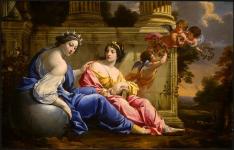
The Muses--Girls Worth Working Two Jobs For

One NEA statistic that surprised me is that the percentage of the workforce occupying artistic jobs—specifically, architects and designers, performing artists, visual artists, authors, and university teachers of art, drama, and music, has stayed in the 1% to 2% range of the entire labor force since 1970. Given the size of the American population, that suggests between 1.5 and 3 million people labor in the arts despite the job insecurity and poor pay. Maybe the U.S. isn’t quite as philistine a place as is commonly thought.

Cheers,

Friedrich

posted by Friedrich at October 5, 2002


Comments


Post a comment
Name:


Email Address:


URL:


Comments:


Remember your info?