April 17, 2003
Comedy for the Ages
Michael:
Thanks for the link to Dave Barry’s column on taxes (which you can see here.)
After reading Mr. Barry’s column, which is, as usual, very funny, I was struck by just how long I’ve been laughing at his work. And despite having been enjoying Dave Barry for at least a decade, it turns out I was relatively late to the Barry party: he’s actually been cranking this stuff out for 20 years. That means he’s produced roughly 1000 columns. Yikes! (Along the way he’s also tossed off some 24 books.)
This got me to thinking about the nature of what might be termed “long-haul comedy.” What permits someone to keep being funny year after year? (And don’t bring up such tired theories as (1) drugs, (2) unhappy childhood, (3) divorce and (4) more drugs. We all know these things are useful inputs for comedy, but they can’t account for sustained comedy.)
Seeking an explanation, I turned—as I often do—to the greatest repository of information on earth: Google. Simply typing in “humor longevity” (and then, after some hard thought, “comedy longevity”) I came up with the following explanations offered by various sages of the Internet.
1. The Blackstone AudioBooks Hypothesis: Avoid Shrillness
Wodehouse’s longevity is found, like Keillor’s News from Lake Wobegon, in his ability to poke without being brackish or brutish. He shuns the shrillness that diminishes comedy and that is found too often in other dens of entertainment-such as American politics.
2. The Larry Wilde Hypothesis: Be Warm and Fuzzy
The platform performances of Larry Wilde -- in addition to his books, television, stage and concert appearances -- have kept millions of people laughing for almost four decades. More than the humor, however, it is the humanity that has made him America's premier motivational humorist and earned him such enduring success.
3. The Kurt Kilpatrick Hypothesis: Use Detailed Research on Your Audience and Be Sure To List Your Educational Credentials:
Kurt Kilpatrick has been a professional Humorist and Motivational speaker for twenty-five plus years. He is skilled at the Art of using Humor in Business and always works hard to relate his humor and message to the audience. It takes extra work and detailed research but the end result always pays off. Kurt Kilpatrick can add That extra spark at any meeting that will make the event fun, exciting, stimulating, memorable and extraordinary! Doctor of Jurisprudence, Cum Laude, 1978, Jackson School of Law at Mississippi College. Bachelor of Science, Cum Laude, 1971, Communications and Journalism, University of Southern Mississippi.
4. The Art Buchwald Hypothesis: Avoid Acknowledging Your Own Mortality, Especially To Yourself:
For example, humorist Art Buchwald says he thinks less about dying than about his funeral, for which he hopes "everyone will get the day off and work very hard on their speeches."
5. The Chile Peppers, Sex and Football Hypothesis: Eat Right and Stay Fit :
…Adam lived to a ripe old age and so did Able. Their recipe for longevity? Grow peppers, make hot sauce and eat plenty of it. Have sex all the time and play and or watch lots of football. If you can do all those at once, so much the better!
(This is contained in a sort of infomercial, The Real Garden of Eden, by Michael H. Jackson who describes himself as Staff Humorist of PyroPepper.com. I don’t know how long Michael H. Jackson has been humorizing, but it seemed like a controversial and potentially important theory.)
6. The Certified Speaking Professional Hypothesis: Communicate in a disciplined way that life is fun, funny and filled with magic:
DENVER, Colorado, USA. July 18-Denver business humorist and motivational speaker Brad Montgomery [whose tagline is "Life is Fun & Funny. And Filled with Magic."] has earned the National Speakers Association's Certified Speaking Professional (CSP) designation. …"You know they (CSPs) have achieved a certain discipline that puts them in a category all their own;they have passed the test of longevity; they have proven themselves. It makes a difference today and will continue to make a difference in the meeting planning industry."- Marolyn Wright, Program Resources
7. The Mark Russell Hypothesis: Be Well-Informed And Write Your Jokes At The Last Minute:
Russell is well informed, and his humorous commentary about the foibles of Washington's politicians rise above the basic jokes told by most comedians. And he has fearlessly performed his PBS specials live, a point underscored when Russell reminisces about jokes and songs he has written within hours of specific political events. Mark Russell's 25 Anniversary Special is a fitting tribute to a unique career which, while built on perishable material, has somehow managed to attain longevity.
8. The Matt Groening Hypothesis: Be A Cartoon Character & Appeal to All Ages
It would be redundant to go on and on about the success of The Simpsons. Creator Matt Groening recently summed up the reasons before a group of TV critics in Hollywood, pointing out the characters on The Simpsons are blessed with "eternal youth" because of the animated format. Homer, Bart and other family members never age. Springfield looks the same. But beyond the obvious appeal of animation, The Simpsons' producers have kept the series fresh by regularly using social commentary that appeals to all age demographics.
9. Finally, there’s the Libertarian/Internet Hypothesis: Be a Libertarian and Support the World Wide Web
Dave Barry is a libertarian humorist. Among his many books are Dave Barry Slept Here and Dave Barry Is Not Making This Up. Many of his hilarious columns are online.
I think all of these hypotheses have a good deal to offer us in our study of long haul humor, even though many appear contradictory or to be the products of deranged minds. I’m confident, however, that someday the truth will come out. By then, however, I plan to be in a non-extradition country.
Cheers,
Friedrich
March 10, 2003
Fiction Books -- Taste Triangulating redux
Michael:
In reading your posting, Fiction Books -- Taste Triangulating, I realized in scanning your list of authors that I have read books by only two of them—Mssrs. Westlake and Kundera. That got me to thinking about why I don’t read more contemporary fiction.
Partly, it is a result of a shift in my taste over the years. Today, I simply prefer the mysteries of fact to those of fiction, the ungainly shape of true stories to the smoother shape of made-up stories. These true stories reach me largely via biographies and works of history (and very occasionally from the pens of “fiction writers” like Saul Bellow who seem, at least today, to be writing ultra-thinly fictionalized versions of real-life family history). This shift seems to have occurred about the time I had children—I don’t know whether that timing amounts to coincidence or causation.
Thinking back, however, I realize that since childhood I’ve preferred older fiction to contemporary fiction—by “older” I can mean writing that is a mere 10 or 20 years old at the time I read it. Truly contemporary fiction—especially if it in any way is making claims for its artistic merits—has way too much anxiety and ambition floating around in it. (Joyce Carol Oates? No thanks.) I find those qualities to be like static in a radio broadcast, preventing me from hearing the music being played.
I also find that the sheer volume of contemporary fiction writing gives me unpleasant intimations of mortality. Given my limited time and resources for reading, why not utilize the inexorable friction of history to grind away the mud and leave the diamonds? I would bet that any fiction you could actually lay your hands on that's 150 or more years old would be of markedly higher quality than whatever is on the new fiction shelf at your local bookstore. I have never read Racine, but if I had to chose between his collected works and those of Rushdie, Morrison, DeLillo, Richard Powers, David Foster Wallace or Thomas Pynchon, I’d head for Racine every day of the week. I would certainly prefer to read everything I’ve never gotten around to reading by say, Stendahl--no matter how minor--to a “greatest hits” collection of the above contemporary writers.
In what may be a connected issue, I’ve always found it extremely irritating when writers (or artists, for that matter) are dismissed for not being sufficiently “of their time” or praised for possessing this same quality (as if they could be anything else.) Virtually every time I can detect someone as being “of” an era--at least one that I’ve actually lived through--I regard it as a sign of artistic weakness rather than strength—since to me such era-specificity almost always means incorporating a contemporary cliché in place of an original thought.
A few years ago it dawned on me, glancing through the New York Times Review of Books at tale after tale of violence, rape, child molestation, et al, that this fiction wasn't the product of the writers' personal life experience; it was what those lazy bastards had been watching on television! Perhaps today's "serious" fiction would be more compelling it it didn't spring largely from within the bowels of the media culture.
Cheers,
Friedrich
January 15, 2003
Philip K. Dick and Sci Fi Gnosis
Michael—
As you may remember at our Lousy Ivy University, when I should have been writing term papers or thinking seriously about my future I hung out in the library reading whatever amused me. In a comfortable little lounge that I didn’t discover until I was a senior I came across a history of Gnosticism. This has always seemed like a stroke of luck to me, intellectually, because Gnosticism is one of those energizer bunny ideas that keeps on showing up in one unexpected context after another. Plato, the Christian Gnostics, Manichaeism, the Kaballah, Theosophy, New Age mysticism, The Matrix, all contain echoes of the thought that the world that we wander through is a dark, delusional, screwed up place and that our spiritual home, our true reality, to which we must struggle to ascend, lies on another plane accessible only through mystic insight or gnosis, achieved either by contemplation or via divine revelation. On an emotional level, if our deepest desires and urges seem constantly frustrated in this world, if we feel at root that “things shouldn’t be like this,” that’s because this world isn’t really real, but rather a kind of nightmare we’re trying to awaken from.
When I picked up Philip K. Dick as an adult I discovered that I had read many of his books as a teenager indiscriminately gobbling up my local library’s collection of sci-fi. Of course, since it had been nearly two decades since I had read them I had almost forgotten them--resulting in a very Dickian ghost memory as I read them again 20 years later.
Of course, to call Dick a “science fiction” writer is a bit of a misnomer: the futuristic settings of his novels just give him permission to cut loose from the constraints of psychological realism and get on with setting up his Gnostic allegories. The situations of his books are often hilariously complicated, as I have found trying to summarize them for friends:
“Well, um, in Ubik, the hero—Joe Chip—is an employee of a psychic protection agency in a future world where reincarnation has both been scientifically proven and can be delayed, so it’s possible to communicate with the dear departed for a while. The plot gets going when the agency is hired for a big job on the Moon and then their team of psychic operators is double-crossed and the charismatic protection agency boss gets killed. When Joe and his fellow psychics try to accompany the bosses’ body for burial, Joe starts getting weird spirit messages from his boss (words written on mirrors, television commercials featuring his boss with messages directed at Joe, etc.) and of course the world they travel through keeps slipping further and further back into the past…”
I remember giggling and thinking that I had never run into anything that was quite so transparently allegorical, at least not since "Pilgrim's Progress." (And, of course, Dick is a great deal funnier than Bunyan, at least as I remember the old boy.) But I can't claim to have been fully aware of how closely his ideas track what might be termed “orthodox” contemporary Gnosticism until I did some research for this post. To pick one example of many, this quote from a Gnostic website (which you can visit here) could be utilized quite directly in a plot summary of “Ubik” (and many of his other books):
Death does not automatically bring about liberation from bondage in the realms of the Demiurge. Those who have not attained to a liberating Gnosis while they were in embodiment may become trapped in existence once more. It is quite likely that this might occur by way of the cycle of rebirths. Gnosticism does not emphasize the doctrine of reincarnation prominently, but it is implicitly understood in most Gnostic teachings that those who have not made effective contact with their transcendental origins while they were in embodiment would have to return into the sorrowful condition of earthly life.
In any event, when I started reading Dick in earnest I was emotionally open to the fundamental concept of Dick’s fiction, which is the "unreality" of reality. After spending my first twenty-odd years of life in a sort of mental straitjacket—during which time my reality principle could have been summed up as "if it frustrates me, it must be real"—I had recently kicked over the traces, gone to art school, and then, in an improbable plot twist, been sent to take over the European office of a company I was doing some work for. It was in a London bookshop that I re-discovered Dick. His books were a perfect expression of my emotional state: reality, after resisting me like a concrete block, had suddenly become permeable to my desires, and thus not quite real. I wandered around London feeling as if the streets and curbs and buildings and trees weren't entirely solid.
I also spent a lot of time listening to Roy Orbison. I’m not quite sure why, but Roy Orbison and Philip K. Dick go together like wine and cheese—in combination they tend to reinforce each other. Interestingly, many of my favorite Dick novels were written contemporaneously with Orbison’s music—the late 50s and the early 60s. Yes, I know it’s hard to believe, but Dick’s aesthetic—while a perfect fit for the Sixties (mysticism, paranoia, explicit pyschedelic drug references et al)—was in fact fully developed before the rest of the world caught on to what the era was going to be about. I wonder what it must have been like to be perfectly in tune with the zeitgeist of a particular era and then actually live through it. I suppose it may have been terrifying to see your subjectivity turn into other people's objectivity. Dick’s regrettable reaction, in any case, was to develop a serious drug problem that finally killed him off prematurely.
In my late 40's I have no energy for sitting around and arguing whether or not Philip K. Dick was actually a writer of "serious fiction." I mean, what kind of a qualification is that, anyway? He certainly seemed serious about his Gnosticism, in a deeply neurotic sort of way. And while I’m no advocate for Gnosticism as a literal explanation for the world, emotionally I can understand its appeal across the centuries. If you don’t get it, try picking up one of Dick’s books—say, “Ubik,” or “Do Androids Dream of Electric Sheep?” or “The Man in the High Castle” or “The Three Stigmata of Palmer Eldritch”—and put on some Roy Orbison in the background. What a buzz.
Cheers,
Friedrich
P.S. I originally tried out some of these "thoughts" (to over-dignify them) in a comment on Polly Frost's wonderful 'blog, "Notes from the Velvet Crypt." I would strongly urge you to check it out here.
December 15, 2002
Writing for a Living Redux -- Yvonne Harrison
Friedrich --
Yvonne Harrison, who lives in New Zealand and makes a living as a technical writer, got in touch a few weeks back. I asked her what it's like to work in her field, and I asked for her reflections about how it affects her experience of (and pleasure in) writing. She wrote a wonderful and informative note back, which she's agreed to let me reprint here.
So, a guest posting, by Yvonne Harrison:
Every writer dreams of earning their living as a writer. Getting paid for their prose is up there with the thrill of getting published for the first time. For many the lifestyle of the writer holds much appeal as well. The prospect of never setting foot in an office, of being able to set up your own writing schedule, of having your very own writer's study usually occupies a considerable chunk of the writer's romantic and long-held dreams about writing.If they're anything like me they discover that it's not that hard to make a good living out of writing. The only problem is that it's not creative writing. There are a myriad of jobs out there that involve stringing words together to form a sentence but as many a (non-creative) writer learns, the job of being a writer can quickly kill any ambitions to be another type of writer.
Unfortunately being a non-creative writer also tends to scupper any illusions about living the solitary writer's life of writing for four hours in the morning at the local cafe while nursing a latte. The problem is that earning a living as a writer usually involves office politics, and a nine-to-five day in a Dilbert like cubicle all of your very own...
Just take my career (job) for instance. I'm a technical writer. There are many good points to this job. I'm a contractor so I can happily pay my mortgage, buy food and other essentials of life as well as save for holidays or the new computer. I've just started working from home for a lot of my contracts, so I really am living the writer's dream of typing away within my very own writer's study.
A big component of technical writing is analysis, so it forces me to think logically and clearly so this helps with plot construction in stories. Additionally, users don't have time to wade through stylish prose or convoluted sentences so it teaches writers to get to the point. Quickly. With as few words as possible.
Unfortunately the big down side to the job is that it makes creative writing a tough challenge. I wrote a novel while I worked as a technical writer. The technical writing project was under some tight deadlines. So I would get to work at 5.30 am in the morning, write all day until about 3.00 pm then get home and try to work on my novel until about 8.00 pm. Quite frankly it was an idea born of stupidity.
By the time I finished the novel (three years because I did so many drafts) I was a wreck. I haven't attempted anything serious (or long) since I finished and went and hid the manuscript in my sock drawer. I continue to be a technical writer because I get good money for something I enjoy but my one ambition to be a creative writer is being slowly eaten away by the sheer grind of spending (literally) all damn day writing.
So for those considering careers as writers so they are earning money as writers (but not as creative writers :-) my advice would be to carefully consider this seemingly brilliant plan before proceeding. Yes, the initial thrill of writing and getting paid for it will be quite heartening and flattering to your ego.
The fact that you may find it tough to face something as simple as replying to your e-mail with any joy is a definite downside. Additionally the amount of self discipline you have to summon up to complete a creative project may just be the thing that finally drives you stark raving mad....
Many thanks to Yvonne.
Best,
Michael
December 06, 2002
Writing Software
Friedrich --
Do you dislike Word as much as I do?
I suppose it's an OK piece of software, and using it to write certainly beats longhand or a typewriter. But I'm offended by it. It's really a tool for making documents, optimized more for memos and reports than for helping you get your thoughts down.
As a tool for writing, it's a lumbering beast determined to inflict on me its rather sinister desire to do favors. (Why do so many Microsoft products want to do me favors? I feel the way a restaurauteur does when the Mob offers to do him a favor.) My copy has to be actively stopped -- apparently at the end of a gun barrel -- from turning asterisks into bullets, for instance, and from underlining grammar and spelling it doesn't approve of. I don't care if there are ways of stopping this behavior, I don't want it starting in the first place.
Feeling offended isn't a good mental state to be writing in. And, besides, writing and document-making are two different activities, darn it. I'd prefer to have a separate program for each.
But the problem, as I see it, also boils down to something that isn't specific to Word. It's the nature of the word-processor itself. A word processor sure beats a typewriter -- but by all that much? Maybe it's just me, but once I got past the "I never have to retype again" exhilaration, I started wondering: Gee, aren't there better things computers can do to help with writing?
The main job/task/challenge/fun of writing, it seems to me, is to take a vague and cloudy (ie., nonlinear) notion -- something that exists only in your mental space -- and translate it into linearly-arranged strings of concrete words on a real page.
No one has ever asked me for this, but here's the way Michael Blowhard breaks down the act of writing, plus bonus tips. Four steps, as I see it:
1) Collecting data -- whether research, notes, thoughts, or ideas. It's best at this stage to keep things nonlinear. Avoid turning your hunches and notions into anything polished or grammatical. Just note it all down telegraphically. It's important to keep the writing project, however tiny, open-ended even as you begin to give it some definition.
2) Organizing the material sequentially. Imagine how you'd present your material to to a bright friend who's interested in what you have to say. Line your research, ideas and information up in the way your friend would find most helpful and entertaining.
3) Writing your way all the way through. Even now it's best to avoid being too linear. Write a passage at the end of the piece first. Write something from the middle. Do a little work on the second paragraph. Move around inside the piece, and when you get stuck, drop the problem and go to work elsewhere in the piece. The problem will probably solve itself. Painters often work this way -- a little here, a little there. They talk about bringing the whole picture up at the same time. They know that if they overwork one section, the picture will become lopsided.
3B) Taking a break. Nap, eat, walk, watch the tube. Let your unconscious do some work, unimpeded.
4) Going back to what you've done, and fixing it.
I find that Word has very little to offer where such a process is concerned. (And spare me its rotten outliner, please.)
Being a goof and a sucker, I've spent far too much time looking into other computer products that promise to help writers, whether with the actual task of writing or with the creative process itself. I've tried outliners (More for the Mac can be useful), visual aids like Inspiration (pretty good), brainstormers, hypertext writing programs ...
More and Inspiration seemed to me the most plausible of these programs. But after a few months I'd abandoned both of these too. The rest of them ... Lordy, they made you feel like you'd gotten lost in some fruitcake's intricate Kabbalistic system, or like you'd gone to a shrink hoping for one piece of advice and wound up in years of grueling, pointless therapy instead.
But there is one kind of writing program that I have come to love using. I don't make huge claims for it -- it won't unleash any imagination you don't already have. But I use it all the time. It's pretty much, in fact, all I want from a writing program.
On the Mac, the only version of this tool I'm aware of is called Z-Write. I've run across a half-dozen versions of the same product for Windows. The original version of it seems to have been TreePad, created back in the mid-'90s by Henk Hagedoorn; TreePad is the one I use.
These programs are based on something like Windows Explorer -- I'm not a techie! I don't really know what I'm talking about! -- and what they apparently basically are is simple databases for writing and ideas. There are two panels. On the left you make a list of topics -- chapter titles, perhaps, or blogging ideas. On the right is the content. Click on the title of a blogging idea, for instance, and on the right is a window where you can write about that idea.
Here are images from both programs, TreePad first, then Z-Write.


What's so useful about these programs? For me, it's that one file can contain many, many topics, and much writing on each topic. Open the one file, and there it all is -- it's like being able to have 20 or 30 Word files open, and being able to bounce around inside them, and back and forth among them, simply and easily.
You could write a novel in these programs using one file. Each topic could be a chapter, or a version of a chapter. The programs enable you to move the topics around, and to cluster them together. In my blogging file, for instance, I have about 40 topics currently underway. (Look out, world.) I've gathered about a dozen ideas (each one of which I've done some work on) under a master topic called Movies.
I can't emphasize how helpful it is to be able to keep everything pertaining to one project in only one file. No more maneuvering through folders within folders, trying to find one Word document; no more scrolling up and down endless Word documents, searching for that one thing you once scribbled down. No more files slugged things like "ChapterOneV1." Instead, it's all in one place.
The Wife uses a Z-Write file to store all her email. I use a Z-Write file for all my fiction ideas. (Like I say, brace yourself, world.) Bloggers should love this software. When something occurs to me I'd like to blog about, I simply start a new topic in my blogging file. When I want to blog, I simply go to this file -- this one file -- and windowshop. There all my ideas are, laid out before me and eager to please.
TreePad Lite, the basic version of TreePad that I use, is free; fancier versions cost a bit. Z-Write, being a Mac program, costs 30ish bucks. Both are usable and helpful within about five minutes of downloading them.
Then, once you've written -- once you've said what you have to say, or made what you wanted to make -- well, then it's time to pretty the damn thing up. Copy and paste to Word or Quark and go wild. There aren't many "document-making" capabilities in TreePad or Z-Write. So what. As writing tools they're superb.
You can read about Tree Pad and download it from here.
Z-Write can be found here.
Best,
Michael
November 25, 2002
Free Reads -- Q&A archive
Friedrich --
Are you as fond of the q&a form as I am? I sometimes feel sorry for the interviewee, who's often spent years developing a subject and a style and who's now expected to deliver the essential goods in an hour or less. Yet the first thing I do when I get interested in a recent artist is search for q&a's he's done. It's an amazingly efficient way to get up to some kind of speed.
A resource for q&a junkies I hadn't run across before just came to my attention: an archive of interviews with a fun range of book people, from Nicholson Baker to Anthony Lane, readable here. The interviewer, Robert Birnbaum, gives his subjects plenty of space, as well as attentive and sensitive questioning.
Sample passage, from an interview with Alain de Botton:
Birnbaum: Let's talk about the sublime. You introduce this notion as a kind of substitute for traditional religious worship in the 19th century.
AB: The sublime is a feeling provoked by certain kinds of landscape that are very large, very impressive and dangerous. Places like the wide-open oceans, the high mountains ... It's interesting that around the end of the 18th century, people started to say that the feeling that these places provoke in us is a recognizable one and universal one—and a good one. This feeling was described as the feeling of the sublime ... What lies at the center of the experience is a feeling of smallness. You are very small and something else is very big and dangerous. You are very vulnerable in the face of something else. Of course, the other thing that tends to make you feel very small and vulnerable is God, traditionally, in our culture. There is an intriguing synchronicity between the rise of the idea of the sublime and the decline of organized religion. The way many people speak of landscape as of the late 18th century is often in quasi-religious tones or actively religious tones. So if one thinks about people like Thomas Cole going out and painting the American West what they are saying and seeing is the hand of God in Nature.
Lots of good reading to be had here.
Best,
Michael
October 30, 2002
Tacit Knowledge -- Genre Writers vs. Literary Writers
Friedrich --
Another entry in our ongoing attempt to put into words the things people know but that don't make it into the official sources...
In a general sense, there are real group differences between American literary-fiction writers and American writers of genre fiction (horror, romance, mysteries, erotica, graphic novels, etc).
It breaks down this way: Literary writers tend to feel that what they do is a vocation -- ie., a religious calling. Genre writers tend to view what they do as something that's fun -- which doesn't mean that they aren't committed to what they do, or don't fundamentally take it seriously.
Lit-fict writers tend to feel harshly conflicted (a word we New Yorkers love) about money and careers. How could they not? Trust funds make people feel guilty, jobs take up too much time. Everyone hopes to be touched by the magic wand -- to win the respect of the bigtime, and to earn enough money from the writing to pay the bills. Yet nearly everyone winds up next-to-unread, and chasing academic jobs and grants. And isn't it kind of anti-artistic to fret over money and prestige anyway? So pretences and rivalries abound. Genre writers tend to experience no conflicts at all about money and career. Most seem to know that writing fiction-between-covers is an absurd field, but hope to win readers and make money at it anyway. They're straightforwardly happy when and if they do.
Self-serious creatures on an artistic crusade, dependent on a sense of mission and destiny that's forever in need of recharging, lit-fict writers tend to be serious and touchy people -- and difficult on the personal level, to say the least. (Depression, jealousy and resentment are common ailments.) Lugging around egos that are both big and fragile, they make high-maintenance friends and acquaintances. Genre-fict writers tend on the personal level to be easy friends and colleagues. They've got a sense of perspective -- they're doing the absurd thing they do because they dig it, after all. They wish each other well; when someone in the field succeeds, it makes the others happy.
American lit-fict writers: monks and nuns of art, intent on overcoming suffering and achieving redemption through art. American genre-fict writers: on the one hand, happy amateurs, like kids in a garage band; on the other, cheerful professionals who get a kick out of their loony field.
Amazing numbers of exceptions allowed for, of course -- I've found that southern lit-fict writers are often quite cheery and companionable, for example.
Best,
Michael
October 17, 2002
Free Reads -- Steve Sailer
Friedrich --
I love checking in on the protean Steve Sailer (here). He writes enlighteningly about evolutionary biology, he writes sensible political commentary, and he writes smart, brave, always-worth-wrestling-with things about race and immigration. (A standout piece on whether or not the concept of race has any validity is here.)
In addition to all that, he's a movie critic who takes a distinctive approach to thinking about movies, treating their business and popular history not in the usual way (as gossip and matter for facile sociology) but as evidence of what works and what doesn't in the art form. It's a kind of evo-bio approach to writing about the arts -- let's see more of that. He even manages to get off the occasional good, yet informative, anti-P.C. crack, as he does in a review (here) of the Navajos-in-WW2 thriller "Windtalkers."
Sample passage:
The screenwriters...are so terrified of being accused of stereotyping Native Americans that they portray the Navajo with no particular traits. Look, you can't "celebrate diversity" unless you show some diversity. In reality, the Navajo are fascinating. They are possibly the most economically dynamic of all tribes. They were originally invaders from Canada who arrived in the Southwest not long before the conquistadors. Acquiring sheep from white people, they prudently shifted from hunting and gathering to herding, weaving, and crafts manufacturing. While the rest of the Native American population was in catastrophic decline due to European diseases, weapons and alcohol, the Navajo exploded in numbers, much to the distress of their neighbors and rivals, the more conservative Hopi tribe.
You won't find that kind of thing in Film Comment.
Best,
Michael
October 12, 2002
Knowledge Loss
Friedrich --
I was talking about books with an arty guy in his early 20s who's very bright and talented. He has a project in mind, and I was pointing out a few titles he might want to peep at to see how various problems of tone and voice can be handled. After a minute, I noticed that he had a strange, mirthful-foolish expression on his face.
“What’s up?” I asked.
“It’s about books, I was just thinking.”
“Thinking what?”
“Well, I haven’t read any of the ones you’re talking about.”
“You haven’t?”
“I haven’t read very many old books, actually.”
“But you went to a fancy, expensive, exclusive Northeastern private college. Didn’t they have you read at least a few of the great old books?”
“Well, one of the profs there told me that the canon was coming apart, and since this was probably a good thing, I didn’t have to worry about reading any of the great old books. He told me not to worry about it. So I didn’t.”
Best,
Michael
October 11, 2002
New Cultureblog
Friedrich --
A delightful discovery, "Out of Lascaux," an art-history cultureblog run by Alexandra, whose last name I don't know, here.
Sample passage:
As a kid, I used to think medieval art was ugly because it wasn't "realistic". I think most of us think that way when we're young. Then, we grow up and learn why things are the way they are and we look at life differently. Well, most of us. But now I love medieval art, especially Gothic art.
Alexandra's list of permalinks includes some promising-looking blogs -- more to explore!
One of these days the 2blowhards, computer mediocrities both, will figure out how to add new blogsites to our own list of permalinks.
Best,
Michael
October 09, 2002
Free Reads -- John McWhorter
Friedrich --

Have you run across the writing of John McWhorter? A Berkeley prof of linguistics who writes commentary about black/white American racial issues, and one of the freshest voices on the topic I’ve encountered recently. He dares, for instance, to suggest that while racism hasn’t entirely vanished, it’s no longer the main factor holding blacks back. The civil-rights establishment isn't pleased -- what fun!
McWhorter has written (for the New York Post) the best sum-up of the Amiri Baraka-9/11-NJ-poet-laureate debacle that I’ve come across, readable here.
Sample passage:
Stringing together visceral ejaculations does not make one a serious poet, regardless of race. This is clear to everyone when the writer is white. But a sentiment reigns, especially in academic and artistic circles, that the rules of the game are different when it comes to black people.
He's best-known for his book "Losing the Race: Black Self-Sabotage in America." But there's lots of McWhorter to be enjoyed online. The Manhattan Institute's website provides a list of links here.
I've stumbled across a side of McWhorter that I haven't seen mentioned any place else, which is that (unless someone's perpetrating a hoax) he's an avid customer-reviewer on Amazon, with a marked interest in musical comedy. You can check out his likes and dislikes here.
Best,
Michael
October 08, 2002
A Prospect on Prospect
Michael
I guess I gotta get down to my local magazine stand a bit more often. Hunting around for something to read at my dental appointment (don't get me wrong, my dentist is a great guy, but his taste in magazines is not mine), I came across a magazine I haven't noticed before called "Prospect." It's a U.K. mag (my copy came with a large and rather strange sticker marked "Printed in England" stuck on it) which carries the subhead: "Politics - Essays - Argument" and, rather astonishingly, delivers. All you hipsters who are on to "Prospect" can feel free to giggle at my insularity right now, but if, like me, you haven't tried this yet, I would recommend it. A sample quote from "Death of An Idea" by Julian Baggini:
...most of 20th-century Anglo-american analytic philosophy--perhaps the least postmodern alcove in academia--has been based on a rejection of grand systems, such as those of Kant, Hegel and Marx. In its place has been a piecemeal approach to philosophy that is as much opposed to grand narratives as post-modernism. Nor is the rejection of absolute truth the hallmark of a distinct philosophy. There are many ways to be a relativist, not all of them intellectually disgraceful, as Jonathan Ree has recently pointed out in these pages. We cannot locate a philosophy that lies behind these various postmodern positions because there isn't one. What is worse, when people do try to make the lead from postmodernism as a social or cultural phenomenon to post-modernism as a philosophy, they tend to make basic mistakes.
If you want to check out the "Prospect" website, you can do so here.
Cheers,
Friedrich
October 05, 2002
Free Reads -- Philip Roth
Friedrich --
Working in and around the arts, you find yourself having to get past many sweet illusions. (It's either wise up, or go back to school for that business degree.) One of the first illusions I had to let go of, back when I was but a babe, was this: that fiction writers are smart.
It's such an easy assumption to make. School tends to leave us thinking that writers write because they're smart. And there's a perhaps-natural tendency to look at and handle a book and think, Gosh, there must be something special about the person behind it: s/he got published! Wow!
I was as prone to this delusion as anyone when, back in the early '80s, I attended a major international conference of writers. Award-winners from dozens of countries were present. There were panels, speeches, seminars. I ran around with pen and pad, interviewing whoever I could sink my claws into.
What a chance to learn and be enlightened, right? In fact, I'd seldom heard such inane nonsense spoken in my life. Writer after writer, many of them famous, got up to speak -- and delivered naive baloney. The average American burger-flipper has more horse-sense about how the world works, as well as more shrewdness about basic psychology.
Quel surprise: Fiction writers tend to be to hyper-reactive and over-imaginative, often to the point of near-hysteria. It's common for them to feel persecuted, unheeded, misunderstood. Their views of the world often reflect this; as political thinkers, they identify (ludicrously) with the oppressed and the unconscious. They're like children, forever looking for parents who'll take proper care of them. And, gollygosh, if life isn't fair it's because there are bad people (Americans almost certainly, and quite likely Republicans) out there!
My conclusion is that a gift for writing fiction has nothing whatever to do with the ability to reason and make sense of things. Instead, it's a talent, like a gift for singing, dancing, or throwing a football. (I'm deliberately side-stepping here any fancypants games along the lines of: but gee, isn't intelligence itself a kind of talent? And, gee, isn't an athlete's talent a kind of intelligence?...)
I've found that talent and intelligence are best thought of as two different things. It's possible to be very talented yet completely brainless; it's also possible to be very intelligent yet without talents (though, realistically speaking, we all seem to have some talent -- parenting, perhaps, or telling jokes, or taking care of animals. Or, in my case, setting the VCR). Having brains and artistic talent: now that's a nice, if unusual, combo. Add a little common sense into the mix, and you've found yourself a rarity indeed.
What brings these thoughts to mind is a piece in the Telegraph about Philip Roth, who has been doing some (eek) thinking about America and 9/11. He's certainly a very talented guy, and obviously one with ferocious powers of mental concentration. But he also seems to be someone whose reasoning gifts are -- to put it kindly -- perhaps best taken not all that seriously. The piece is readable here.
Sample passage:
Roth: "Language is always a lie; above all, public language. McCarthy used a certain language to hunt communists. That which was used against Clinton is a bit more sophisticated. As for Bush, it's ventriloquists who make him speak."
Hmm. We can't and shouldn't keep artists from talking about politics. But we should definitely make fun of them when they do. Either that, or just not pay much attention.
Best,
Michael
October 03, 2002
Begs the Question
Friedrich --
It’s the rare language-usage error that makes me emerge from my usual apathetic shell, but this one does: the epidemic misuse of the phrase “begs the question.” I almost never see it used properly these days. Writers -- and, perhaps worse, their editors and copy editors -- seem to think “begs the question” means “provokes us to ask,” or “makes me wonder,” or something close to that.
An example is in today's Wall Street Journal. Michael Judge, in an opinion piece about Amiri Baraka’s loathesome WTC poem, writes that “New Jersey’s previous poet laureate, Gerald Stern, recently told the New York Times he was ‘shocked at the stupidity of Somebody Blew Up America,' saying ‘Lies never serve good, and there was hate in it.’ Which begs the question: was there no hate in Mr. Baraka’s earlier work?”
No, no, no, no!
What “begs the question” in fact means is “to assume the truth of an argument or proposition to be proved, without arguing it” (thank you, Oxford desktop dictionary).
The statement “We’re going to publicize the hell out of this excellent blog,” for instance, begs the question of whether or not this blog really is excellent. A not-bad way of understanding this meaning is: You beg a question when you skip over a matter that’s disputable. The question begged isn't what the statement makes you think or wonder, but is instead the matter that’s skipped over.
And here I withdraw back into my shell, there to await the arrival of the real language buffs, who’ll finetune and/or correct me. As well they should: in order to thrive, language (like a city) needs policing. The superego has its functions too.
Best,
Michael
Not a Critic
Friedrich --
After a few recent visits with bright, talented friends who are critics, it occurs to me why I’m not one. (Putting aside all questions of my gifts and credentials, or lack thereof, of course.) Critics, generally speaking, care about their opinions. I mean, really care. Do they want to impose their opinions, and see them prevail? I don’t know. But at the very least, most of the critics I’ve known want their opinion to be out there in public, playing a role (the bigger the better) in forming “the general consensus.”
My opinion just isn't that important to me, and I have a hard time seeing why it should be of much importance to anyone else. (“Opinions are like assholes...”, etc.) The real critic seems to feel that the world needs to know his opinion. Me, I’m grateful to have a few people in my life willing to put up with me, let alone my no doubt tiresome opinionating. The “general consensus”? It gets on fine without input from me. And then it gets revised anyway. So why waste the energy?
For me, an opinion is a small part of a much larger package of responses: feelings, reflections, musings, thoughts, observations, bodily sensations. And lord knows I do love exploring reactions, other people's as much as my own. But that's one of art's functions, to give us excuses to muck voluptuously about in this make-believe-but-oh-so-real way.
Comparing notes=bliss. Fighting over opinions? Arguing about whose is right? Thanks, but I’ll pass.
How do you experience your own opinions?
Best,
Michael
September 13, 2002
Free Reads -- Alan Ayckbourn
Friedrich --
The Telegraph runs a brief but amusing excerpt from playwright Alan Ayckbourn's new book "The Crafty Art of Playmaking," here.

Do you know Ayckbourn's plays? I like 'em: Sly and virtuosic, even while working a familiar dowdy-yet-amusing Brit vein.
Sample passage:
Ironically, when the play went to the West End in the so-called Swinging Sixties, I was asked to reset the first scene to the day before, around 4pm - the argument being that the audiences would be less shocked at seeing a young unmarried couple waking up together in the afternoon than in the morning. The logic in this confounded me. You mean they couldn't have been making love in the afternoon? So much for the traditional unities. I guess Aristotle hadn't reckoned with that one.
Best,
Michael
September 10, 2002
Schopenhauer redux
Friedrich --
Glad to hear you're enjoying Schopenhauer. I'm no Schopey scholar, but I've loved what I've read: grimly (but enjoyably) pessimistic, poetic, influenced by some of my favorite Eastern ideas. Schopenhauer's basic vision of life suits me pretty well, but the writing is what makes me love his work. It's breathtaking. Plus his view of art suits me. Here's a nice passage from Bryan Magee, a British professor who writes first-rate intros to philosophy:
In Schopenhauer's view there is one way in which we can find momentary release from our imprisonment in the dark dungeon of this world, and that is through the arts. In painting, sculpture, poetry, drama, and above all music, the otherwise relentless rack of willing on which we are stretched out throughout life is relaxed, and suddenly we find ourselves free from the tortures of our existence.
For a moment we are in touch with something outside the empirical realm, a different order of being: we literally have the experience of being taken out of time and space altogether, and also out of ourselves, even out of the material object that is our body.
You go, Schopey.

Schopenhauer: Cheerful Zen pessimist
Confirming once again just how shallow and pleasure-oriented I am -- go ahead, call me an aesthete -- I find that I react much more to the quality of writing in philosophy than most readers seem to. The tone, the words, the style, the energy -- all mean a lot to me, at least as much as the ideas. I love and (not that anyone needs to know) basically agree with Hume, for instance. But if he weren't so drily amusing and incisive I wouldn't bother with him at all.

Hume: Cosmic yet bemused
There's more meaning in the writing itself, or so I'd contend, than is usually acknowledged. I remember once discussing Nietzsche with some professor and doing my lame best to ask him why more discussions of Nietzsche didn't take his humor and style into account. (I always found it hard to take Nietzsche's goofy ideas seriously -- but what a dazzling writer.) The prof (a perfectly bright and helpful guy) kept doing his best to steer me back to the exact meaning of the words.
Which was probably the sane and responsible thing to do. Because when you read philosophy scrupulously, it's helpful; you sharpen your brain a bit, you polish your tools, and you find out pretty quickly which team you're cheering for.
But, good lord, it can also be pleasurable, dammit, and that's not nothing. I marvel that that isn't discussed more. But perhaps I'm weird. I find that generally I'm more interested in what reading a philosopher is like than I am in his ideas, which seem to me to be mere parts of a much more rich experience. And in most cases I'd rather talk about the experience than hash over the ideas.
How do you tend to read philosophy? For the ideas alone? For the literary pleasure?
I guess I really should engage earnestly with the substance of Schopenhauer's arguments. But that (zzzzzz) may have to wait a few lifetimes.
Best,
Michael
August 17, 2002
Theory of Amazon 1
Friedrich --
Do you use Amazon.com much? I do as a shopper, and also as surfer -- I can get lost there, and happily so, for hours. As an arts fan, I find its existence and (I hope) success heartening.
I'd also make the case that it's an artistically revolutionary force, if I didn't dislike the word "revolutionary." If I were a betting man, I'd bet that in a hundred years art/lit historians will look back and decide that the advent of Amazon was much more important an art event than, say, any Jonathan Franzen or Toni Morrison novel. Why don't editors/writers/critics/artists/profs discuss this? Could it be that they're -- gasp! -- not listening to me?
I'll bore you with my fullblown Theory of Amazon later -- or, more likely, I'll do it in dribs and drabs, as time and mental energy become available. For today's installment, I focus on one fact: that Amazon has given a number of good writers and critics a venue.
For example, here's an Aussie who's terrific on Popper-ish subjects.
Here's a dazzling Irish film critic, of the annoyingly-radical-grad-student ilk.
Here's an English conservative who's smart and provocative about the Mideast.
Here's another Englishman, this one an elegant and helpful guide to early movies on DVD.
All of them strike me as considerably more interesting and entertaining than 9/10s of the writers commercial (and otherwise conventional) magazines are publishing these days.
All hail the Web. And power to the people --at least those I approve of.
Best,
Michael
August 16, 2002
Blogging, Movie Update
Michael
The job is coming along. Astonishingly, several of my initiatives from earlier in the year seem to be paying off. I'm always kind of wide-eyed with wonder when my ideas actually come to some kind of fruition--financially, I mean.
By the way, do you have the same reaction that I do to seeing some of your opinions on the Web--to wit, uncertainty as to whether the opinions are too extreme/sweeping/unfair? For example, while I appear to smack Kubrick, Altman and Woody Allen some postings ago, the larger truth is that I love and frankly treasure several individual movies by each of them. I mean, I'm not about to disresptect "Thieves Like Us," "California Split," "Dr. Strangelove," "Bananas," "Take the Money and Run," etc. (Not only do I like them, I understand "Dr. Strangelove" was Elvis' favorite movie of all time!)
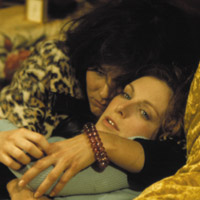
Ann Prentiss and Gwen Welles in "California Split"
On the other hand, I believe the "Economist" style guide maintains that vivid writing results from a two part process--simplify and exaggerate, so maybe strong opinions are their own reward.
As far as my own movie-going activities, I saw "Signs" which I thought was pretty ramshackle if ultimately redeemed by having Joachim Phoenix take on an evil alien with a baseball bat. M. Night is a weird mixture of an eight-year-old comic book fanatic and an adult in therapy, and this time the adult-in-therapy part never quite got out of his head, so thank God the eight-year-old was along to take up the slack.
I also saw "Spy Kids II" which was like eating cake for breakfast: not exactly stick-to-your-ribs fare, but goofy, fast-moving, and good for a sugar rush. Antonio Banderas was brilliant as the blundering, vain but good-hearted dad. I could have used more of Mom (hubba hubba)--are there other movies she's been in? By the way, what do you think of Steve Buscemi? He appears to be having the ultimate stealth career success of the modern acting world.
Cheers,
Friedrich
August 14, 2002
Jack and Diane
Friedrich --
By the way, how was your vacation? Mine was great: Good cancer-test results out in St. Louis (PSA's "undetectable," praisethelordandknockonwood), then a very sweet 30th public-high-school in western New York.
I wonder what your reflections are on growing up in the midwest -- for all intents and purposes, western New York is part of the midwest. Are you as amazed as I often am by how contemptuous big-city types are of flyover country? (You'd think at least a few of them would look at midAmerica and think: Peaceful, prosperous, pleasant -- hmm, maybe they're onto something.) But maybe that just demonstrates what an earnest and easily-shockable mid-American I remain, even after all these years in the big bad city.
Early in my stay in New York, I was comparing notes with a young woman, who asked where I was from. I told her, and mentioned that I was fond of it. She looked me dead in the eye and said, "No you aren't."
New Yorkers for you. At least midtownish, careerish New Yorkers. They either grew up here and think it's the center of the universe and every other place is a joke, or they came here from some other place they spend the rest of their lives hating.
I'm such a small-town midwesterner at heart. Are you? I remember once telling the wife, a big-city girl, how pleasant life in a small town in western New York was for a kid. She was skeptical, so I made her sit through the movie "Breaking Away," which, aside from the whole bicycle-racing thing, might be a documentary about how I grew up. She enjoyed the film but couldn't stop rolling her eyes. She watched it like she was watching something from Timbuktu, it seemed that bizarre to her.

Seedbed of oppression, racism and homophobia?
The weekend of the reunion, full of "Breaking Away"-style kids (although "kids" may not be the best word for people in their late 40s), I had the usual, intense "Why did I ever leave?" stirrings. Short answer: ambitious mother. Longer answer: some interests I wanted to pursue. But neither answer seemed adequate as I made conversation with old friends who've never left town, and who seem at least as happy as I am. So: why did I ever leave? Gulp.
Art question: which movies/books/paintings/etc have done a good job of presenting smalltown mid-American life?
Some offhand answers: "Babbit." "Winesburg, Ohio." "Breaking Away." A few of the early Jonathan Demme movies. "Spoon River Anthology." "Picnic." And my personal favorite, "The Music Man," a towering masterpiece (I would argue this seriously) which also nails the "American salesman" type far better than the awful "Death of a Salesman" did, at least for this son of a salesman.

Poet of the heartland: Sherwood Anderson
I should be coming up with paintings too. Any ideas here? But I think artists have generally done a lousy job of dealing with mid-America, which they see all too often as a nothing but a target to project what they hate onto: racism, homophobia, oppression, warmongering, whatever.
Besides, what's so wrong about saying "please," "thank you," and "sorry" a lot?
Your thoughts? Your vacation?
Best,
Michael