April 16, 2003
Culture and Scale-Free Networks
Michael:
In the May issue of Scientific American, there is an article by Albert-Laszlo Barabasi and Eric Bonabeau on “Scale-Free Networks” that seems, to my mathematically ignorant eye, to have significant implications for the world of culture.
According to this article, the traditional way of studying networks assumed that they were like the U.S. highway system—that is, each node (major city) tends to be directly connected via superhighway to roughly the same number of other nodes. A few nodes had only one connection, most had four or five, a small number had as many as ten, but the number of connections per generally fit a “bell curve” with the largest number of nodes having a middling number of direct connections. (This is known, for reasons beyond my comprehension, as a “random” network.)
However, a different type of network (known as “scale-free”) has recently been widely studied, in which most of the nodes have a very low number of direct connections, and some of the nodes have a very large number of direct connections. This creates what is known as a “power law” distribution, as opposed to a “bell curve” distribution, and is the technical definition of what makes the two types of networks different. For us limited-math types, the key is the fact that the nodes with tons of connections function as hubs in scale-free networks.
An interesting example of such a scale-free network is the World Wide Web, where some pages are hyperlinked to (and from) zillions of other pages, while the vast majority of pages have few links. Examples of scale-free networks that have been studied in biology include cellular metabolism and protein interaction. But what, you say, does this have to do with 2Blowhards and our penetrating study of culture? Well, it so happens than many social networks are also scale-free, as Mssrs. Barabasi and Bonabeau report:
A collaboration between scientists from Boston University and Stockholm University, for instance, has shown that a network of sexual relationships among people in Sweden followed a power law: although most individuals had only a few sexual partners during their lifetimes, a few (the hubs) had hundreds. A recent study led by Stefan Bornholdt of the University of Kiel in Germany concluded that the network of people connected by e-mail is likewise scale-free. Sidney Redner of Boston University demonstrated that the network of scientific papers, connected by citations, follows a power law as well. And Mark Newman of the University of Michigan at Ann Arbor examined collaborations among scientists in several disciplines, including physicians and computer scientists, and found that those networks were also scale-free, corroborating a study we conducted focusing on mathematicians and neurologists.
[You've got to wonder how they divvy up the work in the social sciences, don't you? I mean, we've got a choice between studying the sex lives of Scandinavian blondes and the citation patterns among neurologists. Gee, which one would I chose?]
Assuming that artistic influence and prestige work in a scale-free manner (a hypothesis based entirely on my possibly shaky intuition), it might shed some light on many interesting aspects of our cultureverse. One such aspect is the emergence of art stars, the Shakespeares, the Michelangelos, and the Beethovens (as well as their contemporary equivalents). While in no way denigrating the artistic genius of these figures, they were (or are) in many cases surrounded by other extremely talented artists who do not have the same towering reputations today. Why did these individuals become “hubs?”
Turning to what has been learned from the study of scale-free networks, we can apply what is known about the emergence of such hubs in social networks. Two mechanisms have been identified. One is simple historical growth; for example, in 1990 the World Wide Web had only one page, while today it has over three billion. There is a fairly obvious tendency for nodes that are around when network growth starts to take off to become hubs. Second, there is a phenomenon known as preferential attachment, or the tendency to seek links to nodes that are either known or very well known. As Mssrs. Barabasi and Bonabeau put it:
When deciding where to link their Web pages, people can choose from a few billion locations. Yet most of us are familiar with only a tiny fraction of the full Web, and that sub set tends to include the more connected sites because they are easier to find. By simply linking to those nodes, people exercise and reinforce a bias toward them. This process of “preferential attachment” occurs elsewhere. In Hollywood the more connected actors are more likely to be chosen for new roles. On the Internet the more connected routers, which typically have greater bandwidth, are more desirable for new users. In the U.S. biotech industry, well-established companies such as Genzyme tend to attract more [joint venture] alliances, which further increases their desirability for future partnerships. Likewise, the most cited articles in the scientific literature stimulate even more researchers to read and cite them, a phenomenon that noted sociologist Robert K. Merton called the Matthew effect, after a passage in the New Testament: “For unto every one that hath shall be given, and he shall have abundance.”
Growth and preferential attachment clearly encourage the existence of hubs. When new nodes appear, they connect to the more connected sites, and these hot nodes develop more links than their less connected neighbors. And this “rich get richer” process also favors the first artists to develop reputations in new spaces—the Mannerist nude in the case of Michelangelo, the Elizabethan theater in the case of Shakespeare, Romantic music in the case of Beethoven. Thus the theory suggests that innovation will be a major element in the development of an artistic reputation.
Scale-free network theory also explains, or at least suggests, two qualities that are observable about cultural networks. One is that they are capable of enrolling people (nodes) across significant distances and maintaining a fair degree of internal consistency. To give an example, at any given time, it is usually fairly clear who are the current hot artists, hot opera singers and hot writers in a given culture—which can span continents. How do such ad hoc structures hang together? According to Mssrs. Barabasi and Bonabeau:
[Scale-free networks] can be amazingly resilient against accidental failures…[A]lthough hundreds of routers routinely malfunction on the Internet at any moment, the network rarely suffers major disruptions…Intuition tells us that the breakdown of a substantial number of nodes will result in a network’s inevitable fragmentation. This is certainly true for random networks: if a critical fraction of nodes is removed, these systems break into tiny, noncommunicating islands. Yet simulations of scale-free networks tell a different story…The random removal of nodes [from scale-free networks] will take out mainly the small ones because they are much more plentifyl than hubs. And the elimination of small nodes will not disrupt the network topology significantly, because they contain few links compared with the hubs, which connect to nearly everything.
However, another factor that is apparent in cultural networks is their susceptibility to sudden, often radical, shifts in taste. This seems to be a function of another aspect of scale-free networks: their susceptibility to an attack aimed at the hubs. As our authors explain:
In a series of simulations, we found that the removal of just a few key hubs from the Internet splintered the system into tiny groups of hopelessly isolated routers. Similarly, knockout experiments in yeast have shown that the removal of the more highly connected proteins has a significantly greater chance of killing the organism than does the deletion of other nodes [less highly connected proteins.] These hubs are crucial…
This shows that the most connected nodes—presumably, academics, record company executives, museum staffers, etc. in cultural networks—can, as long as they hold onto to their positions, maintain a viable system of consensus, even if suffering losses among the less connected nodes (i.e., people like you and me.) But when they are replaced, or retire, or whatever, the cultural network of which they are the hubs rapidly falls apart.
Lacking extensive documentation, these are of course merely conjectures, but if anyone goes to the trouble of proving all this, I’d appreciate sharing the Nobel Prize, okay?
Cheers,
Friedrich
P.S. Lynn Sislo at Reflections in d minor has taken up this point in an interesting posting entitled "Popularity." You can see this here.
March 25, 2003
Sisterhood is Forever
Michael:
In researching some aspects of my postings on Impressionism, I have entered new territory (for me, anyway): women’s studies. I went looking for a history of feminism in the 19th century. At least as far as the “Women’s Studies” shelves at my local Barnes and Noble went, I noticed that there weren’t a whole lot of studies present, at least not in my sense of the word. I was looking forward to thick analyses of the demographics, education, employment, reproductive activities, political positions, etc., etc., of women during the 1840s, the 1850s, etc. In short, ahem, facts. Fat chance, buster. At least as far as the titles on these shelves went, what I found were a series of book-length polemics—e.g., “Sisterhood is Forever.” Forever, huh? I pondered, I wonder how they know that?
However, I’m a Blowhard and I take my responsibilities as an informed windbag seriously, so I didn’t abandon ship. I finally found one volume that seemed like it might do the trick: “A History of Women, Volume IV, Emerging Feminism from Revolution to World War.” It was edited by Georges Duby, (a member of the Academie Francaise), Michelle Perrot (Professor of Contemporary History, University of Paris) and Genevieve Fraisse (Research Associate in Philosophy, Centre National de la Recherche Scientifique, Paris), all of whom seemed pretty respectable. And, the clincher, was that it was published by the Belknap Press of Harvard University. So I plunked my $19.45 down and bought the book.
And, it’s true, there are some interesting and rather valuable facts scattered about in the book. (I plan to use some of them in my posting.) But in what I had assumed was the pure temple of objective scholarly research, I found what I would have to describe as a remarkably high incidence of outright opinion, wild overgeneralization and anachronistic reading of past behavior by today’s standards.
Let me give you an example from the chapter “Bodies and Hearts” by Yvonne Knibiehler:
The French term for unwed mother, fille mere, first entered the language during the Revolution and is only now disappearing. For two centuries it connoted an affront to the very logic of patriarchy.
At this point, I start looking around for a footnote—after all, such an affront must have been noted by some of those darn patriarchs over two full centuries. No dice. I skip down a few lines:
To be sure, illegitimate births were not unknown in previous centuries. But between 1750 and 1850 their status changed, as it were. There were a variety of reasons for this: the number of illegitimate births increased, “seducers” were denounced as irresponsible, and the authorities became increasingly concerned about the problem. The number of unwed mothers increased everywhere [footnote 50], although not always at the same pace. In France the illegitimacy rate rose from 3.3 percent of all births in 1790 to 7.4 percent in 1840, stabilizing at between 7 and 8 percent by the turn of the twentieth century. In Paris, however, a destination to which girls in trouble flocked, the rate rose as high as 30 percent in the period 1830-40.
Gee, if nearly a third of the children being born in their city lacked the financial support of fathers, the authorities would have been a bit amiss not to notice something, don’t you think? (Especially in a city where 70% of the population was described as poor?) Moreover, these authorities seem to have blamed the absent father-seducers for the problem. Seems reasonable, if possibly one sided, to me. However, what troubles me is that statement that illegitimacy increased “everywhere” which, of course, I take to mean: everywhere. I check out footnote 50, which refers me to “The History of French Population.” Did the author mean “everywhere...in France”?
A few sentences further we find this passage:
Some women lived as concubines of their children’s father. But the true “unwed mothers” were those deprived of all male support. Nearly all had given in to force, intimidation, or promises of marriage. Ill-protected by the law, defenseless young women remained vulnerable in the countryside as well as in the cites. In fact, public opinion made no exception for rape. [footnote 52] Any girl who gave in, even if forced to do so, was “ruined,” fallen,” unworthy of respect or help. When pregnant, she was thrown back on her own resources, except in unusual circumstances. [footnote 53]
Again, my alarm bells go off regarding the claim that “nearly all” of the women totally deprived of masculine support were victims of rape, intimidation, or lies. There is no footnote. How could the author possibly know this? So now I start looking at the footnotes that are present in the text. Footnote 52 refers me to “The History of Private Life” edited by Michelle Perrot, one of the editors of this series. That seems a bit incestuous for such a strong statement, but let that go. How about Footnote 53? This refers me to “Social Inequality in a Portuguese Hamlet: Land, Late Marriage and Bastardy (1870-1978)” by Brian Juan O’Neill. Does it strike you that our author may be a bit sloppy in generalizing on unmarried pregnant women being thrown entirely on their own resources based only on data from a single Portuguese hamlet?
But even more, it’s the general thrust of this statement that troubles me. These young women are being presented as victims of benighted public opinion. The only other members of society mentioned are authority figures, and these (the patriarchy) are the people presumably to blame for this ugly injustice. But what behavior is being stigmatized here, and who is doing the stigmatizing? If rape is no defense against this stigma, then it would appear that the problem is sexual activity by unmarried women, pure and simple.
Note what is not being stigmatized here: (1) married men having children with their own wife, (2) married men having children with other men’s wives, (3) married women having children with other women's husbands, or (4) married women having children with unmarried men. What links all of these "non-stigmatized" activities? They all involve the access of married women to the genes or financial support of their own husbands or extramarital lovers.
So what group benefits from the tightly defined prohibition on unmarried women's sexual activities? I would venture to say married women are the big winners here.
But, of course, one cannot find discussions of female sexual competition in “A History of Women.” Remember, sisterhood is forever!
Cheers,
Friedrich
March 09, 2003
Why Don't You Know What I'm Thinking?
Friedrich –
Why does a woman expect her man to be able to read her mind? And why does she feel perfectly entitled to act indignant when it turns out he can’t? I’m going to assume this holds roughly true (many exceptions allowed for) across cultures and across time. By the way, have studies been done of this? And if not, why not?
What might be a plausible evo-bio explanation for this tendency? I’ll (bravely and stupidly) try to get the ball rolling here. A woman is hyper-focused and aware of her inner life (her feelings, her body, her urges and needs). When it turns out that her man hasn’t got a clue what the hell she’s talking about, let alone feeling, it’s quite simply a rude awakening, and rude awakenings make everyone feel irritable. So, two questions: why are women so hyper-focused on their inner lives? What evolutionary advantage does this confer?
Question two? Well, what is a man’s role in all this?
Best,
Michael
February 25, 2003
Nature v. Nurture
Michael:
A few years ago I bought a book entitled “Beyond Left and Right.” I thought at the time that I might be in for some genuinely new political thought. Unfortunately, upon examination at home, I found the contents consisted of new fashioned ways to sell old-fashioned left-wing ideas, the desirableness of which were simply taken as a given.
I mention “Beyond Left and Right” because I just read something in the New York Times that feels a lot like it. I refer to Natalie Angier’s column, “Not Just Genes: Moving Beyond Nature vs. Nurture.” (You can read it here.) I won’t keep you in suspense about the similarity; Ms. Angier ostensibly lists examples of how science doesn’t support either position in the political debate over nature or nurture while managing to give the impression of wanting desperately to hang on to the nurture thesis.
Ms. Angier notes what is the politically correct position in science, which is that genes are always dependent on their environment for expression. She also points out that scientists are, like everybody else, politically opinionated:
“Everyone calls themselves an interactionist," said Dr. David Sloan Wilson, an evolutionary biologist at Binghamton University in New York. "Yet often, when you scratch below the surface, you find a sociobiologist who marginalizes the importance of culture, or a social constructivist who hates the very idea of sociobiology, and they end up painting caricatures of each other. True integrative thinking is in the very early stages."
Regrettably, Ms. Angier is among those who aren’t up to “true integrative thinking” at least at the political level. All the examples she selects appear to support a “nature” hypothesis, but viewed more closely (she claims) are really more ambiguous. Oddly, or perhaps not so oddly, she selects no examples that, at first glance, appear to support “nurture” but in reality turn out to be more ambiguous.
Beginning her catalogue of ostensibly erroneously "naturist" thinking she cites phenylketonuria, or PKU. This disease results from a genetically inability to break down phenylalanine, found in foods like milk, eggs, meat and bread. Excess phenylalanine then builds up in the body, resulting in tremors, seizures and brain damage. She argues that because it is possible for sufferers to manage the condition by avoiding foods containing phenylaline, this condition can’t be considered merely “genetic.”
Say what?! Last time I looked, the nature-nurture argument had to do with the ability to create new—and better—human relations by modifying social conditions. That is, the better society is the cause that leads to the effect of better human beings. Lefties, by and large, believe passionately that human beings are malleable enough to be manipulated into virtue by their social environment, while righties, by and large, have a much lower opinion of the malleability of human nature and fear that such manipulations are more likely to have extremely nasty unintended consequences.
For this example to have supported the point that Ms. Angier seems to be making—that human beings are more flexible than hard line righties, or naturists, believe—she would have to show how an improved environment would cure phenylketonurics, not merely observing that they can take actions to compensate for their disability. (Self interested coping behavior is not "nurture" in the sense of this argument.)
Another example Ms. Angier mentions as apparently-but-not-really belonging in the “naturist” camp is the strong attraction of baby mallards to their mother's call. This is so pronounced that even duck eggs brought up in incubators, with no exposure to a mother bird’s voice, prefer the call of a mallard over that of any other bird. Apparently a Dr. Gilbert Gottlieb has rendered this example "ambiguous" by showing that if a duckling is surgically prevented from hearing its own peeps in the egg, it responds as readily to a chicken cluck as to a mallard call.
Forgive me if I find this rather irrelevant as a counter example to "nature." All Dr. Gottlieb has shown is that if you interfere with the mechanism by which ducks brains are imprinted with the preferential birdcall, then the mechanism won’t, er, work. Gosh, that’s a surprise. (Viewed politically, moreover, the idea of implementing such modifications surgically on human populations in order to suppress "natural" development and behavior strikes me as unlikely to catch on anytime soon—no matter how beneficial the resulting social flexibility might be.)
Ms. Angier also quotes a Dr. Richerson on the fact that people are more docile and susceptible to social reinforcement than are chimpanzees. While an interesting fact, it doesn’t exactly convert me immediately to either a pro-nature or pro-nurture political position. Saying that people are more suceptible than chimpanzees to social reinforcement doesn’t say whether this susceptiblity is sufficient to, for example, permit the elimination of the profit motive from human society. (Although it does seem to rule out much in the way of social engineering on the part of ambitious chimpanzee leaders.)
But astonishingly, in making the comparison with chimpanzees, Ms. Angier brings up the following point:
People have tried to raise chimpanzees as they would children, [Dr. Richerson] said, and the chimpanzees are clever and do a lot of humanlike things, but they are not nearly as responsive as children are to praise and scolding. "They're rougher back," said Dr. Richerson. "They're the terrible twos gone berserk."
Gee, sounds like nature to me.
I think the whole point of “naturists”—a viewpoint that has always struck me as far more in touch with reality as I have lived it—is not that people are hard-wired to live in exactly one way. It is that for all of human beings’ flexibility in means, they are fairly inflexible about goals. And social engineering that ignores those goals—or, worse, declares war on them—is either cynically or naively trampling on human nature. Which, like most forms of nature, will generally bite back.
Sort of like those darn chimps.
Cheers,
Friedrich
February 24, 2003
A Feathered T. Rex--Image Evolution
Michael:
According to a story in Scientific American, the evolution of feathers seems to have occurred not in "birds" or even "proto-birds" but in dinosaurs. Specifically, feathers seem to have developed in therapod dinosaurs (the carnivorous types that ran about on two legs with prominent teeth.) Apparently feathers have a host of valuable properties not connected with flight, including being good heat insulators and being waterproof, to say nothing of allowing all sorts of interesting opportunities for sexual display and differentiation. So feathers came first, and flight was something that showed up later (possibly, much later) in the game. One consequence of this is to change the primary definition of birds from feathered, flying bipeds to the longest-running show among the therapod dinosaurs; another is eliminating the question: "Why did the dinosaurs become extinct?"
What astonished me, however, is that the current thinking (if I'm reading this story correctly) is that all therapod dinosaurs may have been feathered, including famous macho nasties like the velociraptor and T. Rex. The cover of Scientific American shows what I think is a velociraptor running around like a really scarey (and rather demented-looking) chicken. I can understand why they didn't even try to illustrate a feathered T. Rex--it would go against too deeply ingrained a mental image. I keep thinking about what the damn thing would look like, and having my visual imagination conk out. I mean, it seems like I just got used to the idea that T. Rex walked around with its body held horizontally, and not dragging its tail.
I wonder if this will hurt the popularity of dinosaurs--trying to match up the idea of T. Rex's tons of bone and tooth with cute ruff of fluffy feathers. Or will it end up pictured more like a giant vulture, dripping blood and dropping gore-stained feathers? (This image seems to be supported by recent theories that T. Rex was too big and slow to hunt and was therefore more of a scavenger or stealer of other dinosaurs' kills.) That has a messy reality that might put off children--and Hollywood, too!


From Tubby to Buff to...Avian?
The "mutation" of T. Rex's image from upright, big-bellied tripod to horizontal menace (sort of a crocodile with really long back legs) at the time of "Jurassic Park" was speedily accepted, largely because it made our boy seem far more fit and athletic--a true tyrant king in tune with 90s ideas of masculine sexuality. But I'm guessing that aesthetic preferences may hold the notion of a feathered T. Rex back for a while. I guess Darwinism isn't just for living creatures; now that I think about it, mental images seem to have a "survival of the fittest" aspect as well.
Cheers,
Friedrich
Free Reads -- Jonathan Rauch
Friedrich --
In this month's Atlantic, Jonathan Rauch writes humorously about introverts (he admits that he's one) and extroverts.
Sample passage:
Extroverts are easy for introverts to understand, because extroverts spend so much of their time working out who they are in voluble, and frequently inescapable, interaction with other people. They are as inscrutable as puppy dogs. But the street does not run both ways. Extroverts have little or no grasp of introversion. They assume that company, especially their own, is always welcome. They cannot imagine why someone would need to be alone; indeed, they often take umbrage at the suggestion.
As you probably suspect, "up with introverts" is his theme. He mentions in passing how tragic it is that politics is dominated by extroverts. I'd push this idea a step further: I think it's tragic that politics is dominated by people who are interested in and care deeply about politics. Why entrust something so important to that awful bunch?
The piece is readable here.
Best,
Michael
February 17, 2003
Fear and Memory
Michael:
I thought you might be interested in an article in the March edition of Discover magazine, entitled “Can the Brain Conquer Fear?” by Steven Johnson. Although it focuses on the specific mechanics of fear-coded memories, what I found most interesting was the discussion of the brain’s multiple memory storage systems. As Mr. Johnson explains:
We’re accustomed to describing someone as having a good or a bad memory, as though memory were a single attribute that covers the entire range of storing and recalling information. We now know that the brain’s memory systems are far more diverse than this. There are systems devoted to explicit or declarative memories, like your childhood recollection of that pet python, and systems devoted to procedural memories that usually involve physical movement, like learning how to ride a bicycle. And then there are emotional memories. If you watch the activity in someone’s brain using a modern fMRI scanner, you see a different profile depending on which kind of memory the subject is conjuring up.
If something—say a movement in the bushes—reminds you of a previous encounter with danger, you’ll have a double reaction. You’ll consciously summon up a declarative memory of the previous scary event, which was originally laid down by your brain’s hippocampus. (“There I was walking down the path and I suddenly realized I had stepped right next to a rattlesnake”). You’ll also unconsciously access an emotional memory, which is routed through your brain’s amygdala. The declarative memory is rich, detailed and slow—it takes a second or two to appear. The emotional memory is virtually instantaneous, and its impact is felt indirectly via increased blood pressure, sped-up heart rate, elevated hormone levels and other physiological responses.
The existence of these two different memory systems explains why fearful people often aren’t very resourceful; their amygdala, having identified a dangerous situation, either falls back on what appears to be its default remedy—simply hunkering down and freezing—or on some other remedy that got them through this situation in the past, like screaming for help. (Interestingly, while there are many neural pathways leading from the amygdala to the neocortex, there are very few running back the other way, so it is difficult for your rational mental processes to win an argument with your amygdala.) And while the amygdala can be trained to associate the scary memory with a more intelligent response, simply explaining to the sufferer the irrationality of his or her phobia or the inadequacy of his or her reaction is a waste of breath. (Remember, the amygdala isn’t listening.)
I don’t know if the mechanism of other emotional memories is similar to that of fear. If they were, however, it would tend to explain a lot of neurotic behavior, and to suggest that trying to modify emotional memories/reactions via “talking therapy” may be fighting an uphill battle. The very existence of multiple memory systems (which suggests the possibility of multiple, parallel versions of many of one’s mental processes) also suggests that classical models of mental health, like that of Freud, are almost certainly too simple and thick-fingered to explain our psychic reality.
Any thoughts on our inner multiplicity?
Cheers,
Friedrich
January 24, 2003
Aesthetic Impacts of Population Dynamics
Michael
According to the Wall Street Journal of January 24, falling birth rates around the world may lead to the global population topping off at around 9 billion in 2050 and dropping to around 8.5 billion by 2075. Granted 9 billion people is still 50% more than we have today, but it’s a whole lot less than the 12 billion that was the estimated peak 10 years ago.
The reasons for this shift are varied, although clearly the largest one (other, possibly, than the impact of governmental population control in China) is the desire and increasing ability of women to limit the number of their pregnancies. My question—given this blog’s continuing interest in evolutionary biology—is how this squares with the desire to perpetuate one’s genes.
The best explanations I could come up with are these: (1) in poor societies having too many children involves a high a risk for women of dying in childbirth, which negatively impacts the likelihood of their children growing to adulthood and reproducing; (2) in urban environments, children cannot contribute to their own upkeep, so excessive numbers of children again reduces the economic resources available to support them to reproductive adulthood. Ergo, in both cases, women are limiting the number of their children to increase the odds of their children’s eventual reproductive success. (Along the way, it’s also less wear and tear on mom.)
The interesting difference between the theories is that in the first situation (which seems to reflect a rural environment), men’s and women’s interests are not aligned—the men would press for more children than the women would want. Whereas, under the second (or urban) theory, men’s and women’s interests are far more aligned, as long as men feel compelled to economically provide for their children. If they don’t feel so compelled, of course, we have another mismatch, in which women limit fertility and men seek out multiple partners.
I wonder if this dynamic explains the shift in art from the Venus de Willendorf—who is loaded with symbols of fertility, including actually being pregnant, to today, when the most desirable woman is the one who obviously hasn’t had her quota of children yet?


Venus de Willendorf; Venus de Victoria's Secret
What a Difference 10 Millenia or So Makes!
Have you read discussions on this topic by a recognized sociobiologist?
Cheers,
Friedrich
P.S. Women may find it amusing to note that in the era of the Venus de Willendorf, being fat was obviously considered deeply erotic (although practically no women got enough to eat to appear this ripe), while today very few women are as thin as the above model (who is, however, probably about as skinny as everyone was in the Paleolithic--excess calories being hard to come by). In short, ladies, you just can't win.
January 18, 2003
Free Reads -- Therapy for Immigrants
Friedrich --
A thought-provoking piece by Sarah Kershaw in the NYTimes about how immigrants bring (and act out) their own forms of distress, depression, and anxiety, readable here. Some fascinating stuff. Asians, for instance, seem to tolerate only about half as much medication as other ethnic groups. And there's apparently no word in Korean for "depression"; Koreans talk instead about being "a little bit irritable," or perhaps having a "down heart."
Sample passage:
Culture-bound syndromes, which are listed in the standard reference of psychiatry, the Diagnostic and Statistical Manual of Mental Disorders, are not limited to Asians. A common disorder among Hispanics, for example, is a condition called "ataque de nervios," in which so much pent-up anxiety and anger come out that a sufferer will fall on the floor and may experience uncontrollable shouting, attacks of crying and heat in the chest, said Dr. Julia Ramos-Grenier, a psychologist and professor at the University of Hartford.
Best,
Michael
January 08, 2003
Free Reads -- Tunes and the brain
Friedrich --
Researchers at Dartmouth using MRI studies have begun mapping out which parts of the brain are involved in recognizing musical tunes.
What intrigues me more than the brain imaging news is the piece of music used in the study. Composed by a recent Dartmouth grad, Jeffrey Birk, it's 8 minutes long and moves through all 24 major and minor keys:
The music was specifically crafted to shift in particular ways between and around the different keys.These relationships between the keys, representative of Western music, create a geometric pattern that is donut shaped, which is called a torus. The piece of music moves around on the surface of the torus.
It moves around on the surface of a torus? Huh? What a virtuosic stunt of musical construction that must be! But what does it sound like?
The press release can be read here.
Found via the Human Nature Daily Review, here.
Best,
Michael
Free Reads -- Chess and intelligence
Friedrich --
Well, gee, if I have a brain cell or two, then I ought to be able to play chess well, right? But what if I can't play chess well? Does that mean I'm simply not smart? But I am, I am, I know I am...
That mini-monologue, which I suspect runs in the head of more than a few people, can now come to an end, I'm thrilled to report. Helen Pearson writes in Nature magazine that brain scans suggest that the "intelligence" part of the brain appears to be inactive when someone's playing chess, or even go. "Inactive" -- that's the word she uses.
Sample passage:
Practice and expertise may actually account for a lot of winning moves. "Most of the stuff we think of as smart is based on experience," says psychology expert John Gabrieli of Stanford University in California.
Pearson does write, though, that the research is preliminary. So maybe that self-torturing little monologue has a few years yet to run.
The article is readable here.
Best,
Michael
December 17, 2002
Progress
Michael—
I see from the NY Times of December 17 that one of my pet theories is being empirically validated:
Dr. [Severino] Antinori, [an Italian fertility doctor] who became famous in 1994 for helping a 62-year-old woman become pregnant by implanting a donor’s fertilized egg in her uterus, says he has a clone pregnancy under way in an undisclosed country. The clone, he says, is a boy, due in early January.Panayiotis Michael Zavos in Kentucky, Dr. Antinori’s onetime partner and now his bitter enemy, says he does not believe Dr. Antinori, and anyway he is working on something even better. Dr. Zavos, an embryologist, says he has collected cells from seven people who want to be cloned, and in the first two weeks of January he will insert the cells’ nuclei into donated human eggs. He promises that, unlike his rival, he will offer DNA evidence that each of the babies born of this adventure is an exact genetic replica of its parent.
And to add a little spice, there are the Raelians, members of a religious cult who believe the first humans were cloned by space aliens 25,000 years ago and who have taken on human cloning as a sacred mission. Acoording to their chief scientist, Brigitte Boisselier, the Raelians now have five clone pregnancies under way, the first of which is to be delivered by the end of this month.
My pet theory? That no amount of banning or regulation is going to stop the more science-fiction-y outcomes of biotechnology and reproductive science from coming to pass. Before this is all over, you’ll see not only designer babies--genetically engineered athletes, scholars and fashion models--but cloning with the goal of harvesting the clone for, er, spare parts. If you can think such a possibility up, I suspect that somewhere, in the not-too-distant future it will happen.

Dr. Antinori--What Kind of Future Does He See, Exactly?
I am not an advocate of any of this stuff—to say I prefer making children the old-fashioned way is an understatement. But if people think buying a few score genes from Cindy Crawford will make their daughter more popular in high school, or buying some from Barry Bonds will make their son more athletic, they may well do it. (Think of it as throwing a few of your genes overboard to make the rest more reproductively successful.) And as for the more gruesome outcomes, human beings have long demonstrated that if they can get the upside of things without personally suffering from the downside they will rationalize their behavior one way or another.
Fasten your safety belts, kids--we're in for a very weird ride.
Cheers,
Friedrich
December 16, 2002
New Ideas: Drawing Blind, Cheap Movies, Evo Lit Crit
Michael—
About once a month I seem to spend a sleepless night caused by middle-aged problems too mundane to mention here. While this is a bit of a problem on several fronts, it does allow me to get some reading done. As a result I went rummaging through the Sunday New York Times about 3 a.m. last night looking for something to read in a hot bath, and was grateful to come across their magazine, which this week is given over to “The Second Annual Year in Ideas.” Several of their stories would seem to be of interest to our readers:
The first story “Even Blind People Can Draw,” showcases the work of Professor John M. Kennedy of the University of Toronto, who has been asking blind people to make drawings. (The blind people in question have been blind from infancy, so they’re not relying on skills developed during a period of sightedness.) Interestingly, from the standpoint of various artistic arguments that have been waged over the years, they make line drawings. The lines are of two types—lines separating figure/ground interfaces (outlines) and “axial” lines where two planes come together (contour). Very interestingly, they also make drawings in perspective! I believe some blind people are better at this than others, but the same could be said about the sighted. As Professor Kennedy notes:
Can blind people draw, using outline? Yes, often somewhat recognizably and at times quite well. Further, occasionally vantage points are explicitly noted. Familiar complex objects such as dogs are difficult for the blind—but they are for the sighted too. And at least one person can draw such objects quite competently.
Granted, mathematical perspective isn’t technically dependent on vision, but it does require knowing where items are in three dimensions—the surprise here is that blind people are capable of determining such coordinates quite accurately by touch, something that appears to have caught the cognitive science community by surprise. For the comfort of the non-academic draftsmen among us, the blind are also capable of deliberate distortion, if they are trying to emphasize some element of the drawing (for example, by putting it in another location than it is “in nature”or to make it larger or smaller relative to the rest of the drawing.) You can read the NY Times article here and an excerpt from Professor Kennedy’s “Drawing and the Blind” here.
The second story concerned the rise of digital filmmaking, headlined “Escape from Turnaround, The.” Of course, the chief attraction of such digital productions currently is their low cost, but—putting my business hat on—low cost is low risk, and low risk allows for a lot more experimentation. One firm profiled briefly in this story is InDigEnt, which produces digital films. Apparently their most successful production was “Tadpole,” which was made for $250,000, shown successfully at a film festival, and then sold to Miramax, which spent $5 million distributing the “film” to theaters. I never saw “Tadpole” and probably never will—for all I know it could be the worst movie ever made—but the implications of this type of movie production are very interesting if one enjoys movies other than studio blockbusters. There are probably less than 10 organizations in the U.S. that can really afford to make $25 million movies and have any interest in doing so; there are undoubtedly hundreds or thousands that could make movies for $250,000. Some of these organizations must possess or be able to hire some genuine talent. You can read the story here.
The third story is “Darwinian Literary Criticism” which you can read here. Regrettably the author of the profile seems fundamentally disdainful of the insights that evolutionary biology can offer (but hey, that’s the New York Times for you—a highly conservative organization that works hard to make itself seem cutting edge.) Sample passage:
…in its current infant form, literary Dawinism is not always as sophisticated as the texts it seeks to critique. For one thing, like Darwinism itself, it posits that characters operate from a small set of shared drives—whereas novels interest us because they emphasize the idiosyncrasy of human behavior.
Of course, that would serve equally well as an argument against any critical methodology that lacks a specialist vocabulary sufficiently daunting to overawe armchair critics. I mean, what exactly is so sophisticated about the view of human nature presented in Marxist literary criticism? But I wander; after all, who am I to question the opinions of such an august literary mind? The real issue is that this trend is making large enough waves to get written about at all.
Cheers,
Friedrich
December 04, 2002
Funky Chickens
Friedrich --
Music has been found have a fast and dramatic impact on the moods of very young chickens, reports Larry O'Hanlon for Discovery News online (readable here).
Sample passage:
In the study, briefly isolated chicks — who quickly cry out in distress — were exposed to music. Their distress calls dropped and they showed other physical signs that the music had quelled their anxiety, apparently making them feel better.
They seemed most soothed by a range of pop music, and calmed less by Mozart's Kronungconzert, said Panksepp. But there's no saying for certain, because chicks can't explain how they feel, he cautioned.
Gotta admire that scientific caution.
Best,
Michael
November 29, 2002
Aesthetics and Dogs
Michael
A story from the New York Times, which you can read here, reveals recent progress made in understanding the domestication of wolves:
On the basis of DNA from several wolf populations and from the hairs collected off 654 dogs around the world, Dr. Savolainen calculates a date for domestication either 40,000 years ago, if all dogs come from a single wolf, or around 15,000 years ago, the date he prefers, if three animals drawn from the same population were the wolf Eves [i.e., the ancestral females] of the dog lineage. Dr. Savolainen believes that dogs originated from wolves somewhere in East Asia, because there is greater genetic diversity, often a sign of greater antiquity, in Asian dogs than in European dogs.
However, there remains a debate over exactly how this domestication took place, given the circumstances:
The dates yielded by dog DNA suggest that wolves were domesticated by hunter-gatherers, before the invention of agriculture and permanent human settlements. But domestication is an arduous process, in which animals must be selected for a particular trait through many generations, by several generations of people. It is hard to see how hunter-gatherers could have foreseen the payoff from domesticating wolves, or would have known what traits to select for.
I want to jump into this debate with my own, er, crackpot theory: humans selected which little wolf puppies to shower attention (and, more importantly, food) on because of how the little rascals looked. In short, the domestication of wolves was guided by (human) aesthetics.
A related story in the Wall Street Journal lists the, ahem, design modifications that occurred as a result of domestication: (1) snouts became smaller and less overtly toothy; (2) ears became floppy; (3) tails curled up or became less rigid; and (4) coloring became more varied and splotchy.


Canines: Early and Late Models
Of course, one can argue about priorities here: whether people deliberately bred wolves to appear cuddly or whether people have learned to “read” canines that have shorter snouts, floppy ears, curled up tails and varied colors as unlikely to devour Grandma and Little Red Riding Hood. But either way, it suggests that people have good reasons to be conscious of “design” in their surroundings and certainly don’t tolerate just anything around them because it happened to wander in from the cold.
Cheers,
Friedrich
November 20, 2002
Free Reads—The Source of Consciousness
Michael
In the Los Angeles Times of November 17, there is an interesting article on brain research—apparently my topic for the month—titled “Stalking the Rational Mind.” It describes how Francis Crick (who won the Nobel Prize for deciphering the structure of DNA 40 years ago) and his band of merry men at the Salk Institute for Biological Studies are pursuing the physical basis of consciousness. (In the invariable habit of scientists, they’ve given this physical mechanism its very own buzz word: the "neural correlate.")
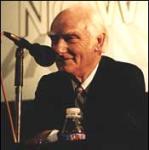
Raider of the Neural Correlate: Francis Crick
One of the things that surprised me about the story is how literally Crick and his number one colleague, Caltech professor Christof Koch, take the idea that the neural correlate is a specific, identifiable mechanism:
At one point, Crick and Koch speculated that the neural correlate of consciousness might be related to the synchronous firing of groups of neurons at about 40 hertz (40 times a second)…But Crick and Koch have more recently backed off some of their broader claims for that theory. Still, they are inclined to believe that the neural correlate is a discrete process in the brain, whether of neurons acting individually or in groups. "Francis and I believe [it] is probably something very specific," Koch says. "The biological model is very specific--so many things in biology are little machines."
You can read the whole story, here. I have no idea if Crick and Koch have a clue as to the nature of consciousness, but I must say the whole thing is quite fascinating. Could you recommend any accounts of current day brain research for the general reader?
Cheers,
Friedrich
November 06, 2002
Evobio Keeps Up With the Times
Michael
I don’t know if you noticed, but the NY Times Science Times section of November 5 was an orgy of sociobiology, or at least stories with a strong sociobiological dimension. The stories included “Weighing the Grandma Factor” which covered the first international conference devoted to grandmothers:
It turns out that there is a reason children are perpetually yearning for the flour-dusted, mythical figure called grandma or granny or oma or abuelita. As a number of participants at the conference demonstrated, the presence or absence of a grandmother often spelled the difference in traditional subsistence cultures between life or death for the grandchildren.
It also included a book review of Dr. Olivia Judson’s “Dr. Tatiana’s Sex Advice to All Creation” which seems to be pretty entertaining, judging from the following:
Eggs are few, and sperm are many. This microscopic-level asymmetry is the root cause of ardent civil war that in every species pits male against male, and male against female. Males, from sea lions and fruit bats to [the] Taliban, are driven to control females’ fertility so as to ensure their own paternity. But a female’s interest usually lies in having many lovers…[enabling her] to guard against male sterility, to ensure diversity in her offspring, to encourage each male in her group to think that he is the father and protect her children accordingly and to encourage competition among the sperm of several males so as to ensure her egg gets the best. “Natural selection, it seems, often smiles on strumpets,” Dr. Tatiana writes without much hint of regret. “Sorry, boys.”

Olivia Judson, Ph.D.,
a.k.a. Dr. Tatiana
Of course, not everyone is a convinced sociobiologist. In “Brain Power: The Search for Origins” we hear from Dr. Terrence J. Sejnowski, a neuroscientist at the Salk Institute in San Diego who is advancing a more culture-centric view of brain development:
“It’s true you can’t separate the question of who we are from the world our ancestors passed through on their way to becoming us,” Dr. Sejnowski said. But that evolution did not occur in the relatively stable savanna described by evolutionary psychologists, he said, but rather during a period of unusual, extreme and rapid oscillations in climate. If the brain evolved any trait during the Peistocene, he declared, it was flexibility.
However, before arguing for a “blanker-slate” theory, Dr. Senjnoski should check in on another story in the section, “On Profit, Loss and the Mysteries of the Mind: A Conversation with Daniel Kahneman”
I think the major phenomenon we [he and Dr. Tversky, his long-time research partner] observed is what we called “loss aversion.” There is an asymmetry between gains and losses, and it really is very dramatic and very easy to see. In my classes, I say: “I’m going to toss a coin, and if it’s tails, you lose $10. How much would have have to gain on winning in order for this gamble to be acceptable to you?” People want more than $20 before it is acceptable. And now I’ve been doing the same thing with executives or very rich people, asking about tossing a coin and losing $10,000 if it’s tails. And they want $20,000 before they’ll take the gamble.
Gee, I don’t know, sounds like a bit of, ahem, genetic wisdom to me. You can read these stories here (although it requires registering.)
Cheers,
Friedrich
October 31, 2002
Free Reads -- Steven Pinker
Friedrich --
The indispensable Steve Sailer does a q&a with Steven Pinker, author of the remarkable new "The Blank Slate," here.
Sample passage:
Q: You argue that the modernist high culture and post-modernist criticism have, on the whole, failed to engage humanity's interest because they ideologically rejected basic truths about human nature. What are some of modern art's flaws?
A: My quarrel isn't with Modernism itself, but with the dogmatic versions that came to dominate the elite arts and bred the even more extreme doctrines of postmodernism. These movements were based on a militant denial of human nature, especially the idea that people are born with a capacity to experience aesthetic pleasure. Beauty in art, narrative in fiction, melody in music, meter and rhyme in poetry, ornament and green space in architecture, were considered bourgeois and lightweight, or products of mass-marketing. Instead, modernist and postmodernist art was intended to raise our consciousnesses, illustrate a theory, or shock us out of our middle-class stupor.
Q: Why, in contrast, did popular culture become so much more, well, popular?
A: Popular culture, to become popular, had to please people, and (at least at its best) it perfected engrossing plots, catchy rhythms and melodies and gorgeous fashions and faces.
Huzzah to that.
Best,
Michael
October 18, 2002
Evo Bio Questions -- Acne
Friedrich --
I couldn't be happier that evolutionary-biology thinking has been flourishing, and at the progress it's made in pushing aside the old models -- Marx, Freud, deconstruction, all of which have long outlived their usefulness, assuming they ever had any. And I couldn't be more eager to see evo-bio forms of thinking make more inroads in the arts.
That said, there are questions the evo-bio crowd hasn't addressed that I'd like to see them take on. The first one is acne. What kind of evo-bio sense does it make that acne is so common during puberty?
I don't think other animals suffer from it -- perhaps you, or some of our readers, know better. Why do we? Acne is so common among human teens that it should probably be considered a standard feature of adolescence. It's uncomfortable, humiliating, and disfiguring. Where's the evolutionary advantage in any of that? What exactly is being selected for?
I seem to recall someone theorizing that acne might be a way of discouraging humans from procreating until they're past it, the idea being that acne is so gross that kids will avoid sex until they have the acne under control. It's a try, which I appreciate, but I'm not sure it stands up. Where's the evidence that teens avoid sex? Or that people are prone to have more sex after adolescence than during adolescence? Or that acne plays a role in people's decisions whether or not to have sex?
Do we have to settle for an explanation along the lines of "well, it's an unintended consequence of blah blah blah"? That'd be lame.
Evo bio people -- give me your ideas!
Best, if still recovering from adolescence,
Michael
October 17, 2002
Free Reads -- Steve Sailer
Friedrich --
I love checking in on the protean Steve Sailer (here). He writes enlighteningly about evolutionary biology, he writes sensible political commentary, and he writes smart, brave, always-worth-wrestling-with things about race and immigration. (A standout piece on whether or not the concept of race has any validity is here.)
In addition to all that, he's a movie critic who takes a distinctive approach to thinking about movies, treating their business and popular history not in the usual way (as gossip and matter for facile sociology) but as evidence of what works and what doesn't in the art form. It's a kind of evo-bio approach to writing about the arts -- let's see more of that. He even manages to get off the occasional good, yet informative, anti-P.C. crack, as he does in a review (here) of the Navajos-in-WW2 thriller "Windtalkers."
Sample passage:
The screenwriters...are so terrified of being accused of stereotyping Native Americans that they portray the Navajo with no particular traits. Look, you can't "celebrate diversity" unless you show some diversity. In reality, the Navajo are fascinating. They are possibly the most economically dynamic of all tribes. They were originally invaders from Canada who arrived in the Southwest not long before the conquistadors. Acquiring sheep from white people, they prudently shifted from hunting and gathering to herding, weaving, and crafts manufacturing. While the rest of the Native American population was in catastrophic decline due to European diseases, weapons and alcohol, the Navajo exploded in numbers, much to the distress of their neighbors and rivals, the more conservative Hopi tribe.
You won't find that kind of thing in Film Comment.
Best,
Michael
October 16, 2002
Gross Over-generalizations -- Women and Baked Goods
Friedrich --
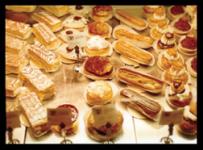
Mood heighteners?
What is it with women and baked goods?
Last night, for example, I was at dinner with the Wife and a woman friend when the talk turned to food and thence to baked goods. The two women lit up: Which bakeries are are the best right now? Have you tried this pastry? How about that one? What about that recipe that was in the Times? And where do you buy your bread? The two gals were still happily discussing these pressing matters when the dessert menu arrived and gave the topic another boost.
I can certainly enjoy a good piece of bread, but I don’t have much to add to these conversations. Do you? Bakeries and pastries .... I’ve got as much to say about them as I do about manta rays or weather balloons. Plus there's the fact that sweet, chewy, grainy things just don’t mean that much to me. Since it seems to be law that eating a lot of them will make you fat, I simply don’t eat them. It’s no big sacrifice.
But women! Their moods go up and down; they really, really care. They feel better when they can have something sweet. They give the bread or cake or cookie a good look and feel before placing it in the mouth. They’re crushed if they have to deny themselves a brioche.

Becoming a woman in Paris
Leafing through some evo-bio book a few years ago, I came across a passage where the (woman) author was writing about differences between women and men. She had looked at tons of cultures, modern and ancient. And her conclusion? She wrote that, if it were possible to factor out all variables, she’d bet that the the biggest difference between the sexes would prove to be that women would spend most of their time searching out and fussing over food, and men would spend most of their time and energy pursuing sex.
Sounds about right to me. To you?
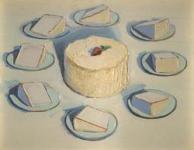
Thiebaud likes painting them more than eating them
Even allowing for many exceptions (male pastry chefs and bread bakers, for instance), doesn’t it seem that women show an amazing affinity for cakey, moist things that tend to the sweet? (I recall, if dimly, some passage in Virginia Woolf where she referred to women and their gabble and their little cakes....) There are male customers at the local high-end bakery, but not many. It isn’t men who make a detour just to see "what’s in the window of that cute little patisserie over there." I don’t recall ever seeing a table of non-gay men babbling while passing around and around a dish of little colored cookies.
Look at the expressions on the faces of the women in the photos accompanying this posting -- angelic, foolish, "caught," eager, blissed-out. You get the impression that they could spend their lives with their hands in the cookie jar. And the symbolism of "the cookie jar" ...
When the waiter arrives to take the dessert orders, the Wife, while considering her options, invariably executes a little emotional circuit -- roughly, from shyness and fluster, to glowing, gasping and beaming, to a kind of sexualized boldness as she finally makes her decision -- she claims I'm jealous of her relationship with pastry. She believes, fervently, that if a man really wants to get laid, he'd do well to learn how to cook, and reminds me that the film director Roger Vadim, one of the 20th century's great swordsmen, was a first-rate chef.
What would remain of the pastry and breads business if women gave up eating their products? Donuts for the cops, pizza crust, some pumpernickel (works well with mustard) and burger rolls ...

Well, maybe just one
I wonder if women’s affinity for baked goods is rooted in the move from hunting and gathering to agriculture -- bread and baked goods being by and large products of a relatively settled existence. Gals, settled domestic life, nesting.... Out comes the cookie sheet.
Here’s my theory: Women identify with baked goods. (Before laughing too hard, consider the fact that women obviously identify with flowers. Why not with food?) How so? Well, baked goods... There’s often a sponginess there. There’s often sweetness, juiciness and chewiness: nurturance. There’s the skin or crust, and let’s not forget the yeast. Brooding, gestating, fluffing up and settling down, keeping the flesh and the mood plump, fresh and appealing: Baked goods as metaphor and mirror for women’s flesh and their emotional nature -- which, let’s face it, are very different than male flesh and male moods.
Enormous numbers of exceptions allowed for, of course....
Best,
Michael
September 12, 2002
Free Reads -- Pygmy Negritos
Friedrich --
Steve Sailer talks with George Weber, a Swiss businessman who's knowledgeable about the Pygmy Negritos of the Andaman Islands (in the Indian Ocean), one of the few remaning Stone Age cultures, here.
Sample passage:
It is thought that the surviving Negritos are a remnant population representing an early -- perhaps the earliest -- migration out of Africa of modern Homo sapiens. That such an early population could have survived into our days is a major miracle, made possible only by the Andamanese ferocity toward outsiders and their geographical isolation over tens of thousands of years.
Best,
Michael
September 06, 2002
The Mind, Part 7,342,941
Friedrich --
Another sensible science column by Sharon Begley in the Wall Street Journal, again, unfortunately, unavailable online. This one's about how research is suggesting that we can know little about why we feel what we feel. Some excerpts:
Introspection about the unconscious can be worse than useless...We don't have meaningful access to the causes of our feelings...If you have a gut feeling about love, work or life, it's probably best not to analyze it to death. The unexamined life has its virtues.
All of which jibes pretty closely with some of Michael Oakeshott's arguments -- that, for instance, we're by and large creatures of habit, taste, and temperament, and that that's ok, it's what it is to be human. And that the determination to pick 'em apart -- to make sense of them -- almost always represents the agenda of the power-and-control-hungry "rationalizer." And beware of them.
You'd think this sort of research would make arts critics question what they do, not that many arts critics follow science, even the more popular expressions of science. After all, isn't much of what critics are up to an attempt to explain why a given work of art or entertainment made them feel the way they did?
After years of befouling the air with too many rationalizations of my own, I've come to think that we like what we like and dislike what we dislike just because we do. Education, discussion, adventure -- all these can open us to experiences and pleasures we might not have encountered otherwise. But our responses remain based nonetheless in temperament.
Lord knows that a big part of the fun of following the arts is letting our tastes and pleasures guide us, musing (in my case ad nauseum) about what we encounter. Lord knows it can be fun to give our responses a poke from time to time just to see how they respond. But fancy explanations for what are basically temperamental preferences are usually just disguises for political or esthetic agendas. And are much to be mistrusted.
Or so I've found. You?
Best,
Michael
September 05, 2002
Schopenhauer
Michael
Have you ever read any Schopenhauer? I happened on this bizarre website called "Frownland: Pessimists speaking the truth," here., which has a couple translations of the old boy.
He appears from these excerpts to be a German philosopher who could actually write (very surprising) and who possessed amazing 'tude (not so surprising, but still pretty amusing.) Following is an excerpt from "The Metaphysics of the Love of the Sexes":
So then, after what has been called to mind, no one can doubt either the reality or the importance of the matter [i.e., romantic love]; and therfore, instead of wondering that a philosophy should also for once make its own this constant theme of all poets, one ought rather to be surprised that a thing which plays throughout so important a part in human life has hitherto practically been disregarded by philosophers altogether, and lies before us as raw material.
The one who has most concerned himself with it is Plato, especially in the "Symposium" and the "Phaedrus". Yet what he says on the subject is confined to the sphere of myths, fables, and jokes, and also for the most part concerns only the Greek love of youths. The little that Rousseau says upon our theme in the "Discours sur l'inegalite" (p. 96, ed. Bip.) is false and insufficient. Kant's explanation of the subject in the third part of the essay, "Ueber das Gefuhl des Schonen und Erhabenen" (p. 435 seq. of Rosenkranz' edition) is very superficial and without practical knowledge, therefore it is also partly incorrect. Lastly, Platner's treatment of the matter in his "Anthropology" (sect. 1347 seq.) every one will find dull and shallow. On the other hand, Spinoza's definition, on account of its excessive naivete, deserves to be quoted for the sake of amusement: "Amor est titillatio, concomitante idea causae externae" (Eth. iv., prop. 44, dem.).
Accordingly I have no predecessors either to make use of or to refute. The subject has pressed itself upon me objectively, and has entered of its own accord into the connection of my consideration of the world. Moreover, least of all can I hope for approbation from those who are themselves under the power of this passion, and who accordingly seek to express the excess of their feelings in the sublimest and most ethereal images. To them my view will appear too physical, too material, however metaphysical and even transcendent it may be at bottom. Meanwhile let them reflect that if the object which to-day inspires them to write madrigals and sonnets had been born eighteen years earlier it would scarcely have won a glance from them.
Moreover, his theory of love is extremely sociobiological. Richard Dawkins of "The Selfish Gene" would have little to argue with in this account:
That this particular child shall be begotten is, although unknown to the parties concerned, the true end of the whole love story; the manner in which it is attained is a secondary consideration. Now, however loudly persons of lofty and sentimental soul, and especially those who are in love, may cry out here about the gross realism of my view, they are yet in error. For is not the definite determination of the individualities of the next generation a much higher and more worthy end than those exuberant feelings and supersensible soap bubbles of theirs? Nay, among earthly aims, can there be one which is greater or more important? It alone corresponds to the profoundness with which passionate love is felt, to the seriousness with which it appears, and the importance which it attributes even to the trifling details of its sphere and occasion.
Only so far as this end is assumed as the true one do the difficulties encountered, the infinite exertions and annoyances made and endured for the attainment of the loved object, appear proportionate to the matter. For it is the future generation, in its whole individual determinateness, that presses into existence by means of those efforts and toils. Nay, it is itself already active in that careful, definite and arbitrary choice for the satisfaction of the sexual impulse which we call love.
Cheers,
Friedrich
September 04, 2002
Surf's Up
Friedrich --
The Wife and I drove by a surfing beach recently. There were a few gals on surfboards and a few guys lolling about. But about 95% of the guys were strutting or surfing (ie., showing off their prowess), and about 95% of the gals were oiled, bikini'd and languourous (ie., showing off their desirable flesh, like juicy roasted chickens).
I pointed this out to The Wife. She, a sexy, fit 6 footer who could probably bench-press me, laughed and said, "And so it ever shall be."
One of many reasons we get along so well.
Best,
Michael
August 30, 2002
Sigmund vs. Science
Friedrich --
A levelheaded science column by Sharon Begley in today's Wall Street Journal (not online) about the unconscious. Of course there's a lot of mental activity that's unconscious -- but none of it bears much resemblance to "the unconscious" as Freud imagined it.
Some excerpts:
This isn't Freud's unconscious, that maelstrom of primitive emotions and repressed memories. Instead, the unconscious being excavated by scientists processes data, sets goals, judges people, detects danger, formulates stereotypes and infers causes, all outside our conscious awareness...
This sophisticated system operates under the radar of consciousness not because it has something to hide, as Freud argued, but for the sake of efficiency. We need to process so much information to survive that some of it has to occur unconsciously, much as a computer runs on machine language that no one wants to see on the monitor.
It's a practical matter!
I remember my amazement when I learned years ago that no scientific evidence whatsoever confirms Freud's version of the unconscious. What kind of baloney had been sold to us? Why had anyone accepted it? Why did anyone continue to stand for it?
Much science in fact directly contradicts the Freudian model. Example: "repressed memories." Studies strongly suggest that the more awful an event, the less (not more) likely you are ever to forget it. (Why should this "discovery" strike anyone as a surprise?)

Why are you resisting my theories?
How did the Freudian version of mental and emotional life get as far as it did? I suppose it's like asking why Marxism got as far as it did, and maybe the answer is the same: they were all-enveloping replacements for traditional religion at a time when many were losing their religious faith.
Freud and Marx both had a charismatic, prophetic fervor that came across in their visions and their writing -- they had a hypnotic effect, like cult leaders. You read them and you feel pumped. And they both offered redemptive goals that one could at least imagine achieving: Freud, to integrate one's personality; Marx, to overcome class divisions. Thank heavens: something to look forward to! A goal to pursue!
My contribution to this discussion is to suggest that Freudianism and Marxism were attractive because they made life seem dramatic. They gave it a storyline (however ludicrous). They added color, fire and spectacle, and many people seem to want those in their lives.
What a relief that both of these cults are losing their grip. (And how satisfying when science confirms one's own hunches!) Will academia ever catch on?
Have you read Frederick Crews's attacks on Freud? Fantastically satisfying (and impressive) displays of intellectual carving-up. The expressions of outrage and wounded dignity (usually in the form of thunderous personal attacks) from Freudians that followed publication of Crews' essays and books only added to the deliciousness of it all.
Best,
Michael
August 29, 2002
Tales of Sociobiology
Michael
Two short tales of the left’s reactions to sociobiology. The first is set during my least-favorite decade, both personally and ideologically.
On 15 February 1978, a young woman carefully poured a pitcher of ice water onto the head of Edward O. Wilson while he sat waiting to address an audience at the annual meeting of the American Association for the Advancement of Science. A band of accomplices joined their pitcher-pouring confederate on stage to wave placards and chant, “Wilson, you’re all wet.”….
By his own account, he was utterly surprised to have achieved the kind of notoriety that evidently inspired his band of youthful appointments. But Wilson is also known as the “inventor” of sociobiology, having published a book of coffee table dimensions in 1975 entitled “Sociobiology: The New Synthesis.” In the interval between the book’s appearance and the AAAS meeting, a group of Wilson’s colleagues at Harvard University did some publishing of their own. Richard Lewontin, a leading geneticist, and Stephen Jay Gould, just beginning his own rise to fame and fortune as a writer on matters evolutionary, were among the authors of a manifesto printed in the New York Review of Books.…
In their broadsheet, Lewontin, Gould and fellow co-signers declared that Wilson had produced a theory that could be used to justify the political status quo and existing social inequalities. Worse, according to them, sociobiology was founded on the same kind of pseudoscience that was used as a foundation “for the eugenics polices which led to the establishment of gas chambers in Nazi Germany.”…

Although Wilson soon responded in print to these unnerving charges, the vehemence of the opposition to sociobiology and the personal nature of the initial attack and follow-ups colored the general view of Wilson and his apparent creation…
As a result, to this day many persons, academics and nonacademics alike, have the sense that sociobiology may be slightly or substantially tainted, all the more so because Gould has continued over the years to cast aspersions on the discipline and its practitioners…
In this he has found allies in various academic camps with some feminists and social scientists especially eager to dismiss sociobiology as misguided at best and socially pernicious at worst…
Wilson’s postmortem of the affair is straightforward and plausible…The mid-1970s were years of intense political activity on campuses, much of it initiated by left-wing professors and their students who opposed the war in Vietnam. At Harvard University, the war and various other injustices came under fire from a number of scholars of the Marxist or semi-Marxist persuasion, including Wilson’s colleagues Lewontin and Gould. Lewontin and another colleague wrote at about this time, “As working scientists in the field of evolutionary genetics and ecology, we have been attempting with some success to guide own own research by a conscious application of Marxist philosophy…”
Marxist philosophy is founded on the premise of the perfectability of human institutions through ideological prescription. Therefore, persons with Marxist views were particularly unreceptive to the notion that an evolved ‘human nature’ exists, fearing that such a claim would be interpreted to mean that human behavior cannot change. If our actions really were immune to intervention, then the many ills of modern societies could not be corrected….
Lewontin and his fellow members of the Sociobiology Sudy Group managed to convince themselves and some activist students that the sociobiological approach would offer ideological support to the enemy, namely, the rich and powerful who resist social changes that would benefit the poor, the disadvantaged, and the female members of society. By making an example of Wilson, a fellow biologist, they presumably hoped to make a dramatic statement that would highlight their own political positions and advance their goals. To some degree, the strategy worked…
[T]he Sociobiology Study Group and their allies in another organization called Science for the People did generate great publicity by publicly tarring Wilson with a connection to Nazis and eugenicists. As a result, they did indeed reach a large audience, albeit at the expense of “sacrificing” a fellow biologist, something that Lewontin and company do not seem to regret.
-- John Alcock, “The Triumph of Sociobiology”
The second suggests that Darwin may have been correct; even left-wing opinions may actually evolve…over a long enough timeframe. (Although ordinarily left-wing thought seems to be far more fundamentalist in structure—in the beginning was Marx.) The following was published in 1999.
To be blind to the facts about human nature is to risk disaster. Consider hierarchy. To say that human beings under a wide range of conditions have a tendency to form hierarchies is not to say that it is right for our own society to remain hierarchical; but it is to issue a warning that we should not expect to abolish hierarchy by eliminating the particular hierarchy we have in our society…When the Bolshevik Revolution in Russia abolished both the hereditary aristocracy and private wealth, a hierarchy soon developed on the basis of rank and influence within the Communist Party, and this became the basis for a variety of privileges...

Seeing this tendency to form hierarchies as inherent in human beings helps us to understand the rapid departure from equality in the Soviet Union…The point is: what egalitarian revolution has not been betrayed by its leaders? And why do we dream that the next revolution will be any different? None of this shows that hierarchy is good, or desirable, or even inevitable, but it does show that getting rid of it is not going to be nearly as easy as revolutionaries usually imagine. These are the facts that the left needs to grapple with. To do so, the left needs to accept and understand our nature as evolved beings.
--Peter Singer, “A Darwinian Left: Politics, Evolution and Cooperation”
I'm reading (surprise, surprise) "The Triumph of Sociobiology" and re-reading Paul Johnson's "Intellectuals"--what scum lefties are!
Cheers,
Friedrich
August 21, 2002
Eat this
Michael
From a review by Joan Acocella of Felipe Fernandez-Armesto's Near a Thousand Tables: A History of Food:
But Fernandez-Armesto agrees with other historians that most cannibalism has been motivated not by physical hunger but by spiritual need. The Papuan Orokaiva, like many other cannibals on record, eat their enemies in order to capture their souls; the Gimi women of the Papuan highlands, until quite recently, ate their deceased menfolk in order to give them a congenial resting place. (" 'We could not have left a man to rot!' protest the women.") Fernandez-Armesto regards these practices as merely an extreme example of the attachment of symbolic meaning to food, and he compares them to contemporary 'health' diets aimed at enhancing one's beauty or tranquillity or moral worth. 'Strangely,' he writes, 'cannibals turn out to have a lot in common with vegans.'
--the New Yorker, August 19 & 26, 2002, p. 164
Cheers,
Friedrich