March 26, 2003
Free Reads -- Saddam's Painter
Friedrich --
Those giant images of Saddam? The heroic, neo-Stalinist ones that hang apparently everywhere in Iraq? They had to have been made by someone, right? But who? The Financial Times' Roula Khalaf had the wit to track down Salam Abed, a painter whose work has contributed much to the Saddam myth. The piece can be read here.
Best
Michael
December 19, 2002
One Size Doesn't Fit All
Michael—
Going through the deluge of comments on my recent posting on Photography and Painting, what struck me most, other than the degree of passion aroused by the discussion, was the way in which many of the comments restated the drawing vs. color debates of the French Academy of the 18th and 19th centuries.
(To ultra-briefly recapitulate the war of the Rubenistes and the Poussinistes: does color make a shoddy appeal to our base, sensual natures while drawing speaks to our nobler, intellectual selves, or is color a critical artistic means of avoiding our overly rational intellects and communicating directly with our deeper emotions? In actuality, this discussion was by no means new even three hundred years ago: I recall a remark by Tintoretto to his son in the 16th century: “While beautiful color may sell paintings down by the Grand Canal, great art is made by strong drawing, which can only be learned by laboring deep into the night.”)
It was one of those great controversies that can go on forever—and will, because both positions are right, or can be for different people.
There is a line of dialogue from Pulp Fiction which goes (more or less): “Which do you like better, Elvis or the Beatles? A lot of people like both, but nobody ever liked them exactly the same.” In the film two people who had been thrown together were using this distinction as a useful shortcut to learn more about each other. Elvis people, in other words, are a different subspecies from Beatles people.
The same could be said about the two camps in the centuries-old Raphael vs. Michelangelo debate. I remember following one critic who was obviously intelligent, broadly knowledgeable about art and in love with the subject, and being puzzled because I never once agreed with his opinion over many years. It was all explained one day when he admitted to an instinctive preference for Raphael over Michelangelo (the reverse of my instinctive preference.) Eureka! I thought. He belongs to the other tribe of humanity!
This principle is by no means limited to art. The Myers-Briggs personality test, for example, sorts people into some 16 different categories as a result of four polarities (introvert-extrovert, sensory-intuitive, thinking-feeling, judgmental-pragmatic.) What’s interesting is exactly how different, in terms of social behavior and motivations, the people in these different categories are. One of those ideas I’ve always wanted to pursue-–but never quite got around to—was figuring out if artistic taste corresponds to these Myers-Briggs categories. (I have a sneaking suspicion that some graduate student wrote his Ph.D. thesis on this subject back in 1958, but I can dream of having an original thought, can’t I?)
It would make sense to extend this idea to politics. For a large chunk of humanity, the main motivation in their work life is a desire for security—beginning, middle and end. Others are driven to make their own ideas and thoughts (good or bad) a reality. Is it wise to have one “welfare state” for everyone? Why not a range of governmental options for people of different personality types? The “Swedish” group would pay very high taxes and get womb-to-tomb security, while the “Hong Kong” group would pay low taxes and receive far fewer governmental benefits. The one-size-fits-all approach to social policy would seem guaranteed to dis-satisfy more people than it satisfies. Come on, I say we give it a try.
Cheers,
Friedrich
December 11, 2002
PBS Responses
Friedrich --
As you remember, a few weeks ago we were lucky enough to be the first blog linked to by the great Arts & Letters Daily, for a posting griping about how boring PBS documentaries can be. What an honor! And what a treat, too: we got as much traffic over the next 3 days as we usually get over the course of about 25 days.
A number of visitors emailed to let us know what they thought of the posting; amazingly, an email or two on the subject is still coming in every few days. But I thought now would be a good time to go back and sum up the response.
A total of 64 emails so far.
Pro-2Blowhards or anti-PBS: 51.
Pro-PBS or anti-2Blowhards: 5.
Miscellaneous: 8.
Feelin’ good! [Dances end-zone victory dance.]
A few comments from the badly outnumbered pro-PBS or anti-2Blowhards faction:
- At the risk of being labelled by you as some kind of PC ex hippie or the like, I confess to not watching any of the sitcom rubbish churned out by the commercial interests of the US TV industry, and to being a great fan of Ken Burns, and PBS in general.
- The essay seemed like it was written by an 11th grader who procrastinated too long, and had to finish the 8 page essay before bedtime.
- I am one of the silent army of PBS viewers who stick with it all, good and bad, because the commercial alternatives are so horrible. Better any amount (well, almost any) of guitar twanging and sepia photos ... than 2 minutes of the Network Horror being shown at the same time.
- Sorry you were bored, but mayhaps you care not for education, information, or learning in general? Unless it's presented with flashy/speedy/graphics or other computer-generated illusions? PBS is the only channel TV worth watching.
(This woman’s email signature included a quote from Gandhi) - As a matter of fact, I do enjoy the pace's contrast to commercial TV's rat-a-tat-tat. Also, I can putter on my computer and housework without missing much if I step away from the program.
Some comments from the triumphant anti-PBS or pro-2Blowhards faction:
- They have certainly lost their former hard-core audience, who have fled in disgust from their PBS channels for better fare elsewhere - and it is not difficult to find. At the same time, they have not attracted new audiences simply because their programs are BAD, and no one wants to watch bad and boring programs.
- I saw this show (the documentary about Stephen Foster we were griping about) quite some time ago. I was amazed at how they got away with running interminable shots of windows and mirrors.
- Thank you for voicing an opinion many of us keep quietly to ourselves.
- I thought I was the only one who thought the same way. I haven't been able to watch any of those documentaries on PBS for years,
- I have felt that way about PBS for years, but I thought the problem was me. They are so damn earnest, dull, pc and prissy. They are the incarnation of all the worst stereotypes of intellectuals.
The Miscellanous crowd was eager to do a variety of things, especially call attention to web sites and swap history-book reading suggestions. One visitor wrote in to ask for career advice -- from me! The self-described “media flunky”! A couple of creationists did their best to rope me in. And two readers wrote to scold me for the way I refer in print to my spouse. An excerpt:
"The Wife"????!!!! Shame on you. I didn't bother to read any further.
Best,
Michael
December 05, 2002
Art Critics -- What Are They Like?
Friedrich --
The National Arts Journalism Program at Columbia University just released the results of a study they did of art critics. My favorite fact: of the 169 writers they looked at, only 3 claim to be politically conservative. The report goes on:
In fact, art critics were more likely to vote for the Green Party in the 2000 presidential election than to vote Republican. Progressive political dispositions underlie art critics' positions on several issues in the visual arts today, including government arts funding and freedom of speech.
Time to call in the Diversity Police?
Asked whether they agree with the statement "Postmodernist theory has a strong influence on the art being made today," 84% of the critics said they somewhat or strongly agree. Asked whether they agree with the statement "Multiculturalism has a strong influence in today's art world," 96% said they somewhat or strongly agree. 61% of the critics agree that "the federal government should make the support of individual artists a policy priority," and 75% "strongly disagree" with the placing of any constraints on publicly funded art.
The writers picked favorites from a limited list of living artists. Their top ten faves from this list are, in this order:
Their least favorite living artists, also drawn from a prepared list:
The report can be looked at more closely here.
Best,
Michael
November 28, 2002
Politics of the NEA, part II
Michael
As I mentioned in my last posting, the NEA was created in large part under political pressure from established arts organizations; from the politically active, wealthy individuals who raised funds and sat on their boards; from the film industry; and from labor unions like the American Federation of Musicians and Actors’ Equity, many of which were associated with the then-languishing New York theater industry. The whole question of the agency’s goals had been left essentially unaddressed in the legislation creating the NEA, other than by such meaningless phrases as
The arts and the humanities belong to all the people of the United States.
The infant agency was a tabula rosa—and thus, in political terms, its budget was up for grabs.
There was not much to squabble over in the first few years, however. The Johnson administration, whose ardor for supporting the arts had dropped off sharply after it became clear that the arts community vociferously opposed the War in Vietnam, had asked never asked for anything more than token (i.e., under $10 million) appropriations from Congress. Paradoxically, that set the stage for a huge increase in funding under Johnson’s Republican successor. Nixon, on taking office, had appointed Nelson Rockefeller’s protégé (and ex-mistress) Nancy Hanks to head up the NEA. Hanks, like the good bureaucratic empire builder she was, recommended a significant funding increase for the NEA in Nixon’s first budget. This would have been a merely predictable but empty gesture except that Nixon’s political advisor Leonard Garment supported Hank’s plans. Garment felt that the increase
…would have high impact among opinion formers…Support for the arts is, increasingly, good politics…you will gain support from groups which have hitherto not be favorable to this administration… [T]he key is in the headline. Doubling won’t do when the money is peanuts—a bag of peanuts becomes two bags of peanuts.
The ever impish Nixon, conscious that he was viewed as a cultural bumpkin, agreed, and on December 10, 1969, asked Congress to approve $40 million for arts and humanities for fiscal year 1971. Hanks then went to work to gain congressional approval. She began by committing most of the requested new money to museums and symphony orchestras, the groups best organized to apply pressure in Washington. Hanks stirred up support by visiting orchestra and museum boards to chat about what they might do if she—and they—got the money. And she delivered in return for their support: throughout her tenure the NEA’s expanded budgets amply rewarded established non-profit art organizations. Museums received nothing in 1970 but more than $9 million in 1974. Orchestras received $2.5 million in 1970 and more than $16 million four years later.
In lobbying for her agency Hanks seldom dwelled on what she called “the great philosophical importance of the arts,” and instead worked to ensure that every congressman whose vote was needed heard from important, supportive constituents. One of Hank’s key allies was Jack Golodner, a Democratic labor lawyer who had become a lobbyist for the American Council for the Arts. Together Golodner and Hanks had people in every state, setting up a telephone tree to mobilize calls and letters, as well as a newsletter, Word from Washington. Funding for the endowment continued to grow throughout Hank’s tenure, eventually reaching $100 million for FY1977.


America's Greatest Art Patrons: Nixon and Carter
Under Jimmy Carter the NEA became more blatantly a patronage scheme. Carter’s appointees to the National Council on the Arts—a body of “arts luminaries” who were supposed to advise the Chairman on grants but in reality merely rubber-stamped staff recommendations—included representatives of unions, state and local arts councils, advocates for various disciplines, trustees of arts organizations, corporate patrons, and arts managers. In short, the Council was becoming a collection of advocates who made no pretense of representing any constituency other than various powerful interests within the culture industry. Alice Goldfarb Marquis points out that this was clearly recognized at the time:
…[National Arts] council member J.C. Dickinson, director of the Florida State Museum…worried that the endowment’s priorities and spending plans came mostly from the “professional segment of the cultural community” and wondered whether “these pressures represent[ed]…the demands of the American people."
Livingston Biddle, an aide to Senator Clayborne Pell who had worked to pass the legislation creating the endowment, became Carter’s choice for Chairman of the NEA. Biddle was a shrewd enough administrator to spot the NEA’s main weakness. He noticed that the vacuum created by NEA’s lack of a clearly defined artistic purpose had been filled by an incestuous relationship between its staff and the arts organizations it funded. Each program area at the agency drew its professional staff from the field it financed, to which they would return after their Washington stint. Together with the “volunteer” panelists—also from the same “field”—who reviewed grant applications, the program staff had essentially become advocates for the funding of “their” art institutions. In short, in practical terms, the NEA had become the creature of its grant recipients.
Intending to at least muffle this dynamic (although what he hoped to replace it with is unclear) Biddle gathered all program directors and informed them that they should consider moving on if they had been there five years or more. Alice Goldfarb Marquis notes that
Biddle suspected that those who served longer had become too involved with their fields and that they were playing favorites among their clients, while losing touch with the public’s needs. When the constituencies of various programs angrily protested, “it convinced me that I was right,” said Biddle. “I saw grants to the same organizations year after year…”
But Biddle didn’t reckon with the power of recipients of arts welfare. Using the very money that the endowment had provided to aid their organization and maintenance, the arts service organizations vigorously lobbied Congress. A new umbrella group for arts lobbying was formed in 1977, the American Arts Alliance. Its membership at first was restricted to such first line organizations as the Metropolitan Opera, the New York Philharmonic, and the Guggenheim Museum, but eventually its membership grew to more than four hundred institutions. Headed by Ann Murphy, whose Capitol Hill experience went back to the early 1960s, the alliance soon became a dominant force for the arts in Washington. Its representatives sat on NEA grant review panels and testified before congressional committees—and, notably, outlasted Biddle and his “reforms.” By FY 1981, the NEA’s appropriation reached its real dollar (i.e., adjusted for inflation) peak of $160 million.
The NEA’s lack of a political program for the arts it sponsored was, of course, also a standing invitation for others in the arts community to pursue their political agendas. In 1977, the Gay Sunshine Press applied for and received $40,000 for an alternative publication featuring illustrations of group sex among men and sex between men and animals. Johanna Went was funded by the NEA, starting in 1983, for a series of performances with props such as dildos, giant bloody tampons, and three-foot turds. In 1985, Thunder's Mouth Press received $25,000 to publish, among other novels, Saturday Night at San Marcos, a description of child molestation showing the children’s enjoyment of the sex games. A 1985 NEA fellowship recipient, Frank Moore, performed "Intimate Cave" at Furnace Theater where he told the audience to remove their clothing and touch each other. In 1987, a grant to the Furnace Theater helped pay for Cheri Gaulke's performance of "Virgin," in which she conducted a mock-religious service in the nude. As Ms. Marquis notes:
By the 1980s, it seemed as though no expression…could get the slightest rise out of art patrons beyond sentimental, perhaps nostalgic, references to a long-dead avant-garde…With the art public all-tolerant, and the wider public disinterested in the arcane and baffling works of contemporary artists, only one audience remained to respond in the classic manner to the strenuous provocations…[of these] artists—Congress.
I’ll pick up the story of how this played out in my next posting.
Cheers,
Friedrich
P.S. The NEA’s appropriations history, graphically displayed (although not corrected for inflation) is available here.
November 22, 2002
The Politics of the NEA, Part I
Michael
In my never-ending series on American culture I thought it was finally time to get around to the NEA. The story of this august institution begins at the end of the 1950s. The social prestige of the arts had reached a new high in American life. Around the country, cultural events formed a new platform on which the affluent and socially ambitious could court distinction. While John Kennedy (like most of his colleagues in the Senate) had never been known as a friend of the arts, he had noticed that the arts constituency was growing and it included many powerful figures: bankers, lawyers and doctors, university presidents and newspaper publishers. After his election, Kennedy carefully used high culture to brand his administration as aristocratic and forward-looking.

Fear of Rocky: Motivation for the NEA
The political question of government support for the arts, however, really became a hot-button issue when New York Governor Nelson Rockefeller (considered Kennedy’s most likely challenger in the 1964 election) upped the ante by establishing a state arts council in 1960—the first in the nation. In doing so Rockefeller rallied both liberal Democrats and ultraconservative Republicans, as well as such powerful labor unions as the American Federation of Musicians, Actors’ Equity, and organized stagehands, electricians and carpenters around the bounty of public arts funding. Sensing a threat, Kennedy moved to enhance his own cultural profile. He sent Arthur Goldberg, his labor secretary, to New York to get headlines by mediating a strike at the Metropolitan Opera. Kennedy also proposed a National Culture Center for Washington, D.C. and appointed a prominent group of artists to its advisory board.
Although Kennedy supported establishing an agency for federal funding of the arts, he was assassinated before this was accomplished. In the months that followed, it became clear even to anxious observers that however little Lyndon Johnson knew or cared about the arts, he was just as determined as Kennedy to woo the arts constituency, and was better at getting legislation passed. Johnson propelled a languishing arts bill through Congress. Although Congressional hearings focused on the problems of individual artists, it was actually a coalition of major arts institutions, New York City’s congressional delegation, the American Federation of Musicians, Actors’ Equity, the Motion Picture Association, and John D. Rockefeller III (puppet-master of Lincoln Center), that helped Johnson put the heat on recalcitrant legislators. On September 16, 1965, the House and Senate agreed on legislation establishing the National Endowment for the Arts and the National Endowment for the Humanities.
There was a significant gap in the legislation, however: to wit, what was the National Endowment of the Arts supposed to do? To what purpose was it to spend the $2.5 million allocated to it the first year? The congressional committee reviewing the bill affirmed that the endowments’ principal objective was
…the encouragement of free inquiry and expression…conformity for its own sake is not to be encouraged…no preference should be given to any particular style or school of thought or expression. Nor is innovation for its own sake to be favored. The standard should be artistic and humanistic excellence.
While a remarkable collection of fine sounding phrases, this is completely vacuous as a plan of action. How is excellence to be judged, if there is no “style” or “school of thought” to set goals and determine standards?
To captain this rudderless ship, Johnson appointed Roger Stevens—a successful real estate investor, Broadway producer and Democratic rain-maker—as the first chief of the NEA. Stevens knew the score politically, and began by calling on each senator and representative. He would pull out a list of the trustees of the larger arts institutions in the politician’s district and point out that the names overlapped with a list of major political donors. The politicians quickly took his point. Moreover, a major selling point on behalf of arts funding was that the arts constituency could be bought cheap. With federal expenditures for 1969 of less than $8 million, politicians recognized that supporting the arts reaped an astonishing harvest of good will among people who mattered.
However, the lack of any clear direction to the fledgling agency remained a significant, if virtually ignored problem. Alice Goldfarb Marquis describes the situation in her book "Art Lessons":
From the agency’s beginnings, brave words about the sacred nature of the arts had obscured the black hole where policy might have resided. By 1968, the U.S. Bureau of the Budget was insisting that the NEA, like every other government program, define its objectives. Trying to comply, Steven’s aide Charles Mark kept formulating goals and Stevens kept brushing them aside. As the budget people pressed him, Stevens finally agreed to justify each grant under such vague objectives as “aid to artistic institutions…wider distribution of the arts…and aid to individual artists,” goals so broad, Mark wrote, that “we never had any trouble deciding where to place each [grant].” When Mark was asked by UNESCO (the United Nations Educational, Scientific, and Cultural Organization) in 1969 to write a paper on American cultural policy, he declined, because in four years at Steven’s side…“I had seen no evidence of a cultural policy of any kind.”
This lack of a cultural policy was not only impractical, it was in striking contrast to most other regimes of government funded art. Just to make this point clear, let’s compare the NEA with the intensely focused government program for the arts in France in the late 18th century. I choose this period because it was probably the most successful bureaucratic governmental arts program in Western history.
French art in the middle of the 18th century was perceived to be in decline by serious critics both in and out of government; it was, in the words of Anita Brookner, widely considered:
…to be hastening down the primrose path of frivolity and fashion, thereby suggesting a disagreeable comparison between the artistic luminaries of Louis XIV and the general libertinage of those of his successor.
This sense of artistic decay was made even more intolerable by the political and military difficulties of this period, which culminated in the disasters of the Seven Years War, during which France lost both Canada and India to the British. Something had to be done, and it was; the government reacted in a very organized way. As Albert Boime reports in his excellent book, "Art in an Age of Revolution, 1750-1800":
…Louis XVI ascended the throne in 1774, and during his reign history painters enjoyed larger subsidies than ever before. Far more puritanical and reform-minded than his grandfather, Louis XVI regarded Boucher’s pictures for Mme. De Pompadour as indecent and wholeheartedly supported the new tendency [neoclassicism]…In December 1774, d’Angiviller presided over the academy and announced that he and the king intended to step up and systematize the commissioning of history painting. He confirmed this the following month when he issued an official declaration…Every year, gifted artists would be assigned four or five history pictures illustrating both ancient and French history, ultimately comprising a series retracing “action and deeds honorable to the nation.”
Moreover, the bureaucrats, realizing that they had no painters currently able to project their message in the “grand style” they required, were determined to create such artists out of whole cloth:
D’Angiviller hoped to project images of French history in the same grand style heretofore reserved for classical antiquity…Vien’s correspondence with d’Angiviller confirms that his selection as director [of the French Academy of Rome] was part of a comprehensive policy governing the art complex. Vien was charged to…systematically expose [the students] to ancient examples, to send them to Naples to view the excavations [of Pompeii], to introduce them to scholars, dealers and officials at Rome who study…antiquities.
In short, the politicians provided their painters with nothing less than (1) a program: history paintings of actions and deeds honorable to the nation, (2) a style: neoclassicism and (3) a training program to nurture it: the French Academy of Rome under Vien. And this training program paid off; in slightly over a decade, Vien’s pupil J. L. David produced a masterpiece (“The Oath of the Horatii”) and inaugurated a century and a half of unprecedented French dominance of the visual arts.
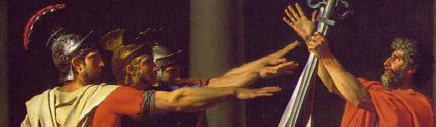
J. L. David, The Oath of the Horatii, 1785 (detail)
Political Art: You Get What You Ask For
Although, ironically, this painting has come to be seen as foreshadowing the French Revolution, it is more historically accurate to view it as “made to order” to terms of the Royal arts initiative launched by Louis XVI and d’Angiviller: severely Neoclassical in style while bursting with an easy-to-read (as well as deeply, almost hysterically felt) patrotism. In short, the French government developed an arts program intended to fill its political needs, funded it, and educated a somewhat unstable genius to execute it.
In contrast, in creating the NEA, nobody was prepared--at least on the record--to say what it was supposed to accomplish. Well, as we know, nature abhors a vacuum, and in my next posting we’ll see what filled up the policy vacuum at the NEA.
Cheers,
Friedrich
November 15, 2002
Adorno's Self Portrait
Michael
As you may recall, I had a little fun a few months back with a review of Mr. Adorno’s “Essays on Music.” But given his reputation as a major critic of popular culture—higher today than when he was alive—I decided to take a look at Mr. Adorno’s writings. Scouring the Internet, I found a translation of his 1944 essay, “The Culture Industry: Enlightenment As Mass Deception,” written with his collaborator Max Horkheimer. Although it took several readings of this densely worded, convoluted, 16,000-word essay to distill the main concepts—the things I do for 2blowhards!—I think the following summary describes them fairly accurately:
#1—Modern popular culture represents the triumph of fixed entertainment formulas:
Not only are the hit songs, stars, and soap operas cyclically recurrent and rigidly invariable types, but the specific content of the entertainment itself is derived from them and only appears to change. The details are interchangeable…As soon as the film begins, it is quite clear how it will end, and who will be rewarded, punished, or forgotten. In light music, once the trained ear has heard the first notes of the hit song, it can guess what is coming and feel flattered when it does come.
#2—Modern popular culture gains authority from its mechanical reproduction:
The National Socialists knew that the wireless gave shape to their cause just as the printing press did to the Reformation. The…charisma of the Fuhrer…has finally turned out to be no more than the omnipresence of his speeches on the radio, which are a demoniacal parody of the omnipresence of the divine spirit.
#3—Modern popular culture imposes a rigid “house” style on all artworks:
No Palestrina could be more of a purist in eliminating every unprepared and unresolved discord than the jazz arranger in suppressing any development which does not conform to the [rules of commercial music]. When jazzing up Mozart he changes him not only when [Mozart’s music] is too serious or too difficult but when [Mozart] harmonizes the melody in a different way, perhaps more simply, than is customary now.
#4—Modern popular culture converges with advertising:
The highest-paid stars resemble pictures advertising unspecified…articles. [Movie stars are] often selected from the host of commercial models. The prevailing taste takes its ideal from advertising, the beauty in consumption…
With these four ideas Adorno sketched out the salient characteristics of commercial culture in a capitalist-industrial era, and there is at least an argument (if not always a strong one) to be made for his positions. However, he didn’t stop there. He overlaid these points with a unique conspiracy theory, which I would call “The Culture Industry as a Mind Control Mechanism for Monopoly Capitalism.” This theory, although Adorno is a bit sketchy on the details, goes something like this:
#1—Modern popular culture converts citizens into consumer zombies:
The principle [under which the culture industry operates] dictates that [the average citizen] should be shown all his needs as capable of-fulfillment, but that those needs should be so predetermined that he feels himself to be the eternal consumer, the object of the culture industry.The most intimate reactions of human beings have been so thoroughly reified [i.e., reconceived on commercial principles] that…personality scarcely signifies anything more than shining white teeth and freedom from body odor and emotions..
#2—The culture industry’s thought control mechanism is utilized on behalf of the big time monopoly-capitalists:
In our age [social control] is incarnate in the hidden subjective purposes of [culture industry corporate] directors, the foremost among whom are in the most powerful sectors of industry—steel, petroleum, electricity, and chemicals. Culture monopolies are weak and dependent in comparison. They cannot afford to neglect their appeasement of the real holders of power if [their industry]…is not to undergo a series of purges.
#3—The thought control mechanism involves economic coercion:
The [cultural] consumers are the workers and employees, the farmers and lower middle class. Capitalist production so confines them, body and soul, that they fall helpless victims to what is offered them.
#4—The thought control mechanism involves technological coercion:
Real life is becoming indistinguishable from the movies. The sound film, far surpassing the theater of illusion, leaves no room for imagination or reflection on the part of the audience, who is unable to…deviate from its precise detail without losing the thread of the story; hence the film forces its victims to equate it directly with reality…
#5—The thought control mechanism involves sexual coercion:
In the culture industry…[t]he supreme law is that [the consumers] shall not satisfy their desires at any price; they must laugh and be content with laughter. In every product of the culture industry, the permanent denial imposed by civilization is once again unmistakably demonstrated and inflicted on its victims. To offer and to deprive them of something is one and the same. This is what happens in erotic films. Precisely because it must never take place, everything centers upon copulation…In contrast to the liberal era, industrialized as well as popular culture may wax indignant at capitalism, but it cannot renounce the threat of castration.
Mr. Adorno is evidently more than a bit fixated on the topic of control, coercion, confinement and castration. He constantly dwells on the helplessness of the individual confronted with the culture industry and monopoly capitalism, as a few examples may make clear (emphasis added):
The effrontery of the rhetorical question, "What do people want?" lies in the fact that it is addressed—as if to reflective individuals—to those very people who are deliberately to be deprived of this individuality.Conciliatory laughter is heard as the echo of an escape from power; the wrong kind overcomes fear by capitulating to the forces which are to be feared. It is the echo of power as something inescapable.
Pleasure always means not to think about anything, to forget suffering even where it is shown. Basically [pleasure] is helplessness.
This isn’t sociology, it’s a masochistic sexual fantasy. Equally striking are his repeated references to exhaustion, to being gradually overpowered:
…cartoons…hammer into every brain the old lesson that continuous friction, the breaking down of all individual resistance, is the condition of life in this society.The individual who is thoroughly weary must use his weariness as energy for his surrender to the collective power which wears him out.
Everyone must show that he wholly identifies himself with the power which is belaboring him.
This image of monopoly capitalism as a ferocious, exhausting force is of course remarkably similar to the impression made by Adorno’s writing style, which grinds and grinds and grinds, making every point first one way, then another, then another, and then swerving back to repeat itself again even after apparently moving on to other topics. By eschewing any systematic historical context and by making no effort to marshall evidence in support of his arguments, Adorno’s writing style instead consists of making assertion after assertion after assertion, creating the impression not of reasoned argumentation, but rather of an attempt to simply overpower all intellectual resistance.
Adorno evidently struggled all his life to escape the power and influence of his father, Oscar Wiesengrund, a successful Jewish wine wholesaler. As the young Theodore Wiesengrund grew to maturity, he made the first of many “dramatic” attempts to escape his father. His mother, Calvelli Adorno della Piana, came from an Italian Catholic family with a strong musical tradition. By turning his back on the wine business and choosing to study musical composition in Vienna, Adorno attempted to repudiate his paternal inheritance. In Vienna he immersed himself in the challenging work of Arnold Schoenberg, Alban Berg and the Second Viennese School. However, on the brink of an actual musical career, Theodore turned instead to scholarship, getting his doctorate at the University of Frankfort. By 1932 he was associated with the Institute for Social Research in Frankfurt. I would submit that becoming an academic (a rather Talmudic profession) instead of an artist was a way of covertly submitting to his father’s influence. Of course, he had to disguise this capitulation by adopting a Marxist point of view and by championing difficult, avant-garde music that resisted commercialization to demonstrate his rejection of his father’s successful commercial career.
Following Hitler's rise to power, Wiesengrund’s interest in rather mechanical models of personality showed itself when he designed a questionnaire known as the "F" scale which aimed at isolating and quantifying the latent traits of the fascist personality. The Institute for Social Research left Germany for New York in 1934, and Wiesengrund followed in 1938 after three years in Britain. There, at the age of 35, he again attempted to free himself from his father’s power by abandoning the Wiesengrund name along with its Jewish associations and adopted his mother’s maiden name, Adorno. In New York, his interest in “psychology” revived when he got a job on the Princeton Radio Research Project, which was funded by the Rockefeller Foundation and involved a study of the psychological effects of radio on listeners.
I suspect that Adorno felt constant psychological pressure from his father (or from his internalization of his father’s dominant tendencies) which forced him into a series of dramatic gestures of paternal rejection. Equally, and probably unacceptably to his conscious mind, he was masochistically attracted to the idea of giving up, relaxing, abandoning his individuality, submitting to the overpowering embrace. The idea of controlling and being controlled developed an erotic fascination. Consequently he ended up ostensibly suspicious of “pleasure” while luxuriating in dungeon images of coercion, constriction and dismemberment at the hands of powerful, but unnamed, masculine forces.
In short, in this essay, Adorno seems to have produced far more of a self-portrait than an objective analysis of the “culture industry.” Of course, he's hardly the first or the last cultural critic to be looking in the mirror.
Cheers,
Friedrich
November 09, 2002
Libertarians and sci-fi
Friedrich --
One thing I notice over and over that I've never managed to make much sense of is the appeal sci-fi seems to have for many libertarians. Can you help me with this?
I confess that the taste for sci-fi makes me a little suspicious, though this may not reflect well on me. Shooting entirely from the hip... Sci-fi has always struck me as an early-adolescence taste: Superman fantasies crossed with a craving for feelings of, "Ah, to be entirely unfettered from earthly shackles." The storytelling and characters never seem the point; the energy always seems to go instead into things (alternative universes; "philosophy") that don't interest me much as entertainment goals.
I'm happy to admit a) that, having managed to get through about a half-a-dozen sci-fi novels, I couldn't be less qualified to reach conclusions, and b) that this may all reflect nothing but taste and temperament anyway. Still, rightly or wrongly, I tend to be as wary of anyone who's crazy about sci-fi past the age of about 25 as I am of anyone who takes Ayn Rand entirely seriously past that age. Before that age these tastes seem commonplace and harmless. After that age? Well, hmmm.
Musing heedlessly on, I also notice that some libertarians are as prone to utopianism as socialists are, though the two groups dream of different kinds of utopias. The dogmatism of both groups -- they always have the one right answer, and it's always the same one -- can become really oppressive.
An example: there was an attack in Reason magazine on the New Urbanism a year or two ago whose argument was that the New Urbanism is nothing but a (probably socialist) attempt to impose new regulations, and that the only real answer to anything is no regulations.
"OK, but back in the real world..." was my response. The New Urbanism can certainly be criticized (what can't be?), but the piece seemed crazed (and juvenile) in its absolutism, and in its unwillingness to wrestle with what the New Urbanism does in fact propose, which is that, given that (in the real world) a region simply is going to have development regulations, why not minimize them, and tinker with them in such a way that playing by the rules leads to a more pleasant, rather than a less pleasant, neighborhood?
So, I return to my hunch (and my fear): that libertarians enjoy sci-fi more than most groups do because many of them tend to be attracted to utopias, as well as to what's completely unrealistic. I guess what I'm long-windedly getting to is this: that the taste for sci-fi, like the preference for a dogmatic libertarianism, seems to me the taste of immature people who'd rather float off into fantasy than wrestle with what's before them.
I wince as I type these words because I have my own taste in fantasy, namely erotica. And what's wrong with a little harmless indulgence in fantasy, darn it? And I suppose it is harmless provided it isn't taken too seriously.
Yet: dogmatism, sci-fi, fantasies of absolute freedom ... I find it all a little offputting. And, attracted as I am to libertarian and classical-liberal approaches, I wonder what gives. Is it all just a matter of differing tastes in fantasy material? Does it reflect anything of real-life consequence? I do notice that on a practical level I have more of a taste for piecemeal improvement than do the more dogmatic libertarians (who seem to prefer the idea of pushing it all off the table).
Anyway: sci-fi and libertarians -- what do you make of 'em? Is the not-uncommon libertarian taste for sci-fi something meaningless and harmless, or something telling and worth thinking about?
Best,
Michael
November 06, 2002
The Church of PBS
Friedrich --

Stephen Foster: Death by documentary
"Major funding for this program was provided by Sominex...."
Well, not really, but just as well. You have to take your hat off to PBS. Has there ever been an organization more expert at taking juicy subjects and turning them into the purest tedium? I mean, aside from textbook-publishing corporations. (Two exceptions noted: the Michael Pack/Richard Brookhiser documentary about George Washington, website here; and "The Commanding Heights," from the Daniel Yergin and Joseph Stanislaw account of the battle between market forces and faith in government, watchable online -- bless the web -- here.)
I should be a perfect PBS audience member. I'm in a facts-not-fiction phase; I'm devouring history books, reading them at night and listening to them on audiobook during commutes. I’m amazed by how passionate and immediate history can be in the hands of the right writers and thinkers. Why wasn't I able to pay attention back in high school and college? Have I changed? Have I simply discovered the writers who suit my tastes and interests?
So, full of hope, I record PBS documentary after PBS documentary. What could be more alluring than a video presentation of real lives and true stories? You can watch in the company of your sweetie! You can talk about what you're learning as you watch! In fact, it's always a challenge to get The Wife, as addicted as ever to fantasy and make-believe, to settle down in front of a documentary. But sometimes I do succeed...
And we almost never make it through. I've tried the Ken Burns shows; they were gruesomely difficult to endure. I'm pleased that many people watched and enjoyed his series on jazz, for instance, but only because I root for jazz. There were wonderful facts and footage there to be discovered. But why did the series have to be so long, so solemn, and so slow?
This evening the Wife and I sat down to watch the PBS "American Experience" hour on Stephen Foster (link here). Within 15 minutes we were both fighting sleep.
How do they do it? It's as though the people behind these shows are determined to kill all interest in history, or at least my interest in history. I watch the shows wondering who the producers are: grown-up versions of those kids who loved 8th-grade social studies class? And who then went on to major in that vapid field, American Studies?
What a dull exercise in earnest civic uplift the Stephen Foster show was. It might have been put together by a committee of progressive junior-high teachers who like to encourage debate on such topics as "What is America?", and who, no matter what the question, always come up with the same answer: black/white race relations.
Stephen Foster was an important and interesting figure, and I'm sure there are viewers who got something out of the show. But the people who make these documentaries seem terrified of immediacy, and are so devoted to imposing a worthy-nonprofit reading on everything they touch that they won’t let a subject’s own pulse take over. They annex the subject to their own crusade.
As a media guy with OK media-biz antennae, what I find myself observing when watching these shows is less the ostensible subject and more what I picture going on behind the scenes -- the agonies of "consensus vision," in other words. While the footage about Stephen Foster goes by like a lazy river, what dances in my mind is images of fights over turf and ideals, images of careerism disguised as moral worthiness, images of ex-hippies still indignant at authority, images of lives crisscrossed with ambition and moral righteousness.
There was Stephen Foster up on the screen, but hopelessly buried under layers of bureaucratic battles, petty moral and career rivalries, futile attempts to get everyone on the same page, an infinity of small resentments -- the whole tedious, snake-eating-its-tail drama of good intentions. The show was smoothly-enough done; PBS seems able to crank out this American-Studies drivel by the yard. But nothing ever seems to be at stake -- nothing that has to do with Stephen Foster, in any case. Instead, what we get is Stephen Foster, the P.C.-Commemorative Edition.
What is it that makes these shows seem so preserved in arts-administrator amber? For readers who have ambitions to make it in the world of PBS documentaries, 2blowhards herewith offers a partial catalog of put-your-audience-asleep filmmaking tropes. Read, imitate, and make a good career for yourself in public television:
- Shots of sunsets.
- Shots of water.
- Shots of empty Colonial-Williamsburg-style interiors.
- Shots of nothing in particular framed by leafy trees.
- Tracking shots over old piano keyboards.
- Slow zooms back from old sepia photographs -- repeat this move endlessly.
- Nothing-in-particular passages from letters, to be read in nothing-in-particular "period" tones.
- Period songs, to be performed in a prissily nostalgic style.
- For background music, lean heavily on the plink-plonk of a lonely solo piano, or the pulseless noodlings of a ruminative guitar. If you really want to knock 'em unconscious, have a banjo player pluck a few strings really, really slowly.
What seems key is to gut the subject matter of all vitality. Stephen Foster was quite a character. He was turned on as a kid by black and minstrel music, he had the skills of a classical musician, he was one of the first Americans to try to make a go of it as a professional artist, he had huge hits and became a national celebrity, he lost it all, he turned to booze, and he died before the age of 40. He was a proto-pop star, for god's sake. And the music and performance tradition he often worked with, minstrelsy, while it makes us ultra-uneasy today, has the kind of fascination (and diciness) that the history of rock and roll does.
Gosh: material that'd work well given the "A&E Biography" treatment. Heck, what his life is really like is a 19th century episode of "VH-1 Behind the Music" or "The E! True Hollywood Story."
Can't have that on public television!
So let's talk vaguely about "home," and let's frame his life as an American tragedy -- America's so hard on its poor, poor artists, after all. Let's slow the pace 'way down, make only a couple of glancing references to the zippiness and dynamism of his era, and keep everything at a museum-installation distance. And, memo to everyone involved: let's be sure to deliver a rigid, one-note view of the minstrel tradition. In other words, let's take everything in our subject matter that might have a little vulgar life and crush that life right out. Push instead a tone of vaguely idealistic, pained moral anguish.
Phew. Now we've got ourselves a PBS documentary.
Do the PBS history documentaries deliver anything more than those broadcast by A&E, Discovery, and the History Channel? As far I can tell, what we're meant to take as value-added is the cloak of high ideals and good intentions -- which, as far as I'm concerned, comes at the cost of lifelessness, tedium, slow pacing, imposed P.C. interpretations, and a from-dullsville style...
A digression: it occurs to me that the point of view that informs these PBS projects is the same one that has been used at universities to undermine the traditional canon. Yet isn't what's being created with pieces like the American Experience series a de facto new canon?
Can we conclude from this that what the canon battles have been about hasn't been whether or not a canon is a good thing, but instead about whose canon should prevail? Political battles, in other words. If that's so, it seems fair to ask: why should this side's point of view be funded with public money? It's also amusing, if a little sad, that the same people who used to complain about the stuffiness of official history are now making this kind of thing: not quite so stuffy, perhaps, but perhaps even more boring (as well as equally misleading, if in different ways).
I’ve been pretty happy with many of the A&E, etc., history documentaries I've watched. They aren't ideal; I'd prefer to be given a more vivid sense of what a subject meant in the context of its own time. But they're generally snappy; they're more open-minded than the PBS shows; and, praise the lord, they don't force you to peer at their subject matter through the same mournful, sepia, reverent, slow-motion lens.
When I calm down, I find it worth noting that, with such shows as the American Experience series and the Ken Burns epics, PBS has hit on a product that works for some audiences. Even if that doesn't have to be respected, it may still be worth thinking about. I'd love to know more about the shows' fans, for instance. Who are they? What is it about the shows that they enjoy and don't enjoy? I wonder if for some of them the leisurely pacing makes a nice contrast to the rat-tat-tat of commercial TV.
Which leads to my basic objection to the PBS approach -- that it mixes up thoughtfulness with religion. The art critic Robert Hughes once observed that America has almost no tradition of intellectual entertainment. I suspect that part of what he was taking into account was the corny way Americans picture thoughtfulness and education -- as matters of hushed rumination and deep, unanswerable questions; of leaning back in a leather chair and thinking big, melancholy thoughts along the high-school-essay lines of "What is it to be an American?"
Why not instead, Hughes was asking, be alert and crisp; why not instead make connections and keep on the move? (Hughes' own series have been models of this kind of first-class intellectual entertainment.) But the typical PBS history documentary doesn't move with the quickness of alert consciousness and searching thought, and it doesn't tear through the veils either. Intead, it dresses its subject in more and new veils, and then lights candles before the spectacle it has helped create.
We're being sold religion in the guise of history and thought, in other words. The PBS history documentaries are almost all selling the same embalmed gospel: America, her sins and possible redemption, all of it delivered with a tragic-yet-yearning tone, and often with something called "art" or "race relations" placed at the heart of the tale. (Watching these shows, it can sometimes seem as though nothing in America ever happened that wasn’t conditioned by black-white race relations. Even admitting that black-white questions are important in the biography of Stephen Foster, that's still an insult to lots of events, and lots of individuals.)
So I take PBS to be something rather like a church: a factory devoted to generating funding for itself by creating products that appeal both to people’s legitimate interests and to their spiritual neediness. Nothing wrong with that, I suppose, though once again I wonder what the government is doing lending support to such an endeavor.
I don't know if I can face more such PBS tedium. Over the years, I've taped a bunch of PBS shows on good topics, and there on the shelf the tapes still sit. I'd love to know more about their subject matter, but I know in advance what the shows are going to deliver: yet more mournful piano and guitar music, yet more shots of sunsets and water, yet more sepia photographs, and yet more earnest academics denouncing racism -- more brain-dead hours in someone else's church.
For much of the Stephen Foster show the Wife and I were only able to keep awake by playing little games. Let's see, PBS stands for Public Broadcasting System, right? What else might it stand for? The Wife won when she came up with Preposterously Boring and Snoozy.
Best,
Michael
November 04, 2002
Turner Prize: Tate v. Howell
Michael
Intrigued by the furor over UK culture minister Kim Howell’s negative comments regarding the work of the four short-listed finalists for this year’s Turner Prize, I did a little research on the plain-talking minister. According to the Guardian, this isn’t the first time Minister Howell has made blunt remarks:
[Howells] described the royal family last year as "all a bit bonkers" and had to apologise after saying in a Commons debate that "the idea of listening to three Somerset folk singers sounds like hell."
Since he seems like a remarkably perceptive fellow, I thought we could use his remarks to stage a debate over the work of at least two of the four finalists. For the “pro” side of the debate, I took some remarks from the website of the Tate, which held the exhibition and hands out the prize.

Entry of Liam Gillick, Turner Prize Finalist
What the Tate says:
[Gillick’s] art is underpinned by rigorous theorising: he is as much a writer as a maker of objects. However, Gillick's work is shaped by a very visual awareness of the way different properties of materials, structures and colour can affect our surroundings and therefore influence the way we behave. Coats of Asbestos Spangled With Mica (2002), made of coloured Perspex and anodised aluminium, has been created specifically for this exhibition. In this work, Gillick encourages us to explore our bodily and intellectual perception of an altered environment.
What the Minister says:
I've sat under perspex roofs like that in canteens since the mid-1960s. It's not at all interesting. It's very, very boring.


Entry of Fiona Banner, Turner Prize Finalist
What the Tate says:
Banner explores the seemingly limitless possibilities of language, yet at the same time demonstrates how words can often fail us, exposing our inability to convey internal thoughts, emotions and experiences. Since 1994, she has created handwritten and printed texts, which describe feature films or particular scenarios in meticulous detail. Since 2000, Banner has used pornographic film to explore sexuality and the extreme limits of written communication. In the works shown in the exhibition, she transcribes the activities taking place in Arsewoman in Wonderland, an X-rated version of Alice's fictional adventures.
What the Minister says:
I thought it was a piece of pointillism [dot painting] when I walked into the gallery but it turns out to be her description of a porno movie.
As for me--a onetime art student who has personally created installations with his own hands--I must admit that my suspicions as to the seriousness of the Turner Prize committee are aroused by the general vagueness and the lack of impact of the installation art they've been handing these prizes out to. One suspects if the work "read" well enough to convey any genuine heat, it would be rejected as insufficiently shocking to the bourgeoisie, or whoever it seems they think they're shocking.

Turner Prize Presenter
and Media Attention Grabber
I sense the whole ethos of the Turner Prize was best summed up by the fact that last year’s prize was awarded by Madonna, who uttered the following immortal words about the £ 20,000 prize:
Art is always at its best when there is no money, because it is nothing to do with money and everything to do with love," [Madonna] said.
Coming from somebody who pulled in £36 million this year (and a good deal of that from a deal she did with Microsoft to use her song “Ray of Light” to launch Windows XP) those remarks show that Madonna and the Turner Prize appear made for one another. Here’s hoping that she either gives the prize out with equally cogent remarks for years to come or that the prize committee finally wises up and just hands her the check for £ 20,000. She could even generate more publicity by tearing it up--heck, she can afford it.
Cheers,
Friedrich
November 02, 2002
The Emperor Has No Clothes
Michael
Thanks for putting me on to the most recent flap in British art, in which Culture Minister Kim Howells seems to have spoken his mind without pausing to edit it for popular consumption (something you've got to admire in any politician.) I really can't do better with this than just quoting the Reuters' story:
Minister blasts Turner art as "bullshit"LONDON (Reuters) - Culture Minister Kim Howells has blasted the contenders for one of the art world's leading prizes as "conceptual bullshit." He accused the art establishment of being out of touch with public taste and urged a new generation of artists to step forward. Howells was reacting to the entries for the Turner Prize, on show at London's Tate Britain gallery. The prize, derided by its critics as a farce, has been won in the past by pickled sheep and elephant dung. Howells visited the exhibition and left a comment pinned to a gallery noticeboard. "If this is the best British artists can produce then British art is lost," the note read. "It is cold, mechanical, conceptual bullshit."

Plain Talking Culture Minister
Our readers can read the entire story here.
I'm going to be trying to follow how all this turns out. If any of our readers is more hip to the British art/political scene than I am, I would welcome their views and news.
Cheers,
Friedrich
October 30, 2002
Public Art--for the Public?
Michael
I just got back from a few days with my wife in Las Vegas. While there, I read the very interesting “Art Lessons,” by Alice Goldfarb Marquis, a book on arts funding centered largely on the National Endowment for the Arts. In one chapter she discusses public sculpture funded by the NEA. According to Ms. Marquis:
While the NEA strenuously insisted that it was interested only in “excellence” and had no aesthetic or cultural agenda, the internal communications described by [Mary Eleanor] McCombie reveal a bias for certain artists and styles and a…belief in the redemptive powers of modern sculpture. When Northern Kentucky State University selected Red Grooms and Donald Judd to create 100,000 dollars’ worth of monuments for its campus, Ira Licht, the endowment’s public art coordinator, rejoiced at the selection of “excellent artists whom we’ve had difficulty placing.”
I was intrigued to see for myself how credible the NEA’s claim of possessing no aesthetic or cultural agenda was, so I looked up pictures of artworks cited by Ms. Marquis. Regrettably, I couldn’t always find pictures of the actual piece funded by the NEA, so I have included several pictures of similar art by the same artist.

Alexander Calder’s La Grande Vitesse
in Grand Rapids, MI
--$45,000 (1969 dollars) in NEA money

Jose Rivera’s Construction #105
—resembles Construction #150in Lansing, MI
--$45,000 in NEA money

Donald Judd’s Untitled 1969
--resembles Dropped Plane
at Northern Kentucky State University

Carl Andre’s Stone Field Sculpture
in Hartford CT
--$50,000 in NEA money

Richard Serra’s Tilted Arc
in Manhattan
Just to provide some context for my reading, I was spending most of my time wandering up and down the Las Vegas Strip (only occasionally in a drunken stupor), looking at the profilic public art on display:

Fountain at Caesars' Palace

Hall at the Venetian
Viewed from Las Vegas, the idea that the NEA was without a cultural agenda is risible. The NEA had obviously equated "excellence" with a variety of academically-sanctioned art movements of the era such as Minimalism, Earth Art, etc. Although probably not giving what they were doing a second's thought, the NEA's agenda had the effect of validating academically-sanctioned art, and thus validating the role of the academy itself in the cultureverse.
Don't get me wrong, I love public art, and would like to see more of it. I just think that public art should actually connect with the public, not talk down to it.
Cheers,
Friedrich
P.S. As a thought experiment, try imagining that placing boulders in lines on empty lots (essentially, the formula of Carl Andre's Stone Field Sculpture) was a thriving rural tradition, usually performed inebriated, and imagine how eager the NEA would have been to fork over $50 grand to some drunken rube then. No, it helped Mr. Andre a lot to be a college graduate doing something that could be construed as lecturing the suburban public about its relationship with the environment.
Righties, Lefties, Art and Pleasure
Friedrich --
Laurel Panella has been following our discussions about righties, lefties and pleasure from her home in eastern Tennessee. She had these lovely thoughts and observations to pass along:
I live in the middle of the conservative, small town South. (Diverse, within its narrow boundaries.) What I find is that the right defends a positive interpretation of status quo living. They won't be entering any debates on beauty and the arts, except to comment on the changing leaves in the Smokies, or the latest football victory.
The right here is so grounded; they have a strong sense of identity from their deep home and community roots. From my perspective, they honestly need only a drop of novelty. The concept of beauty and pleasure doesn't seem to be an interesting topic of discussion to them. When they do discuss it, they go back to the Renaissance, when art was art, or quote from Southern Living Magazine, with its "gourmet" recipes.
Sometimes I think it's the job of the right to balance out the left. The right doesn't defend cutting edge art, they defend the status quo -- in whatever package it comes. I tend to think this serves a valuable societal purpose. With the left, they’re adventurers, paving the way, so to speak, for the right. The right provides a sense of societal stability that gives the left its courage and footing, to stretch and question boundaries.
I have a lovely group of friends that often debates the ideas you have presented. They of course are all lefties. Personally, I enjoy the challenge of learning from both perspectives without the desire to make one more like the other. The conservative right has so much to offer. But I don't think they'll ever play ball in the world of pleasure and beauty the way some would like.
I tried suggesting that "status quo" pleasures are as legit as cutting-edge pleasures; that football games, changing autumn leaves and "gourmet" recipes represent a perfectly valid aesthetic; that there's no reason to let the left get away with defining art as being necessarily adventurous, or necessarily about questioning boundaries...
But Laurel, who I suspect knows a fancy big-city move when she spots one, was having none of it.
Best,
Michael
October 24, 2002
Free Reads -- Righties and Pleasure again
Friedrich --
Brian Micklethwait at Samizdata.net, here, has been following our gabfest about righties and pleasure, and has now entered the fray. If I understand him correctly (these Brits! So educated and articulate!), he's presenting the notion that while lefties tend to move from personal preferences to entire worldviews -- ie., they want to dominate with their tastes -- righties see taste and pleasure taking place under the auspices of more substantial activities, such as politics, economics and business.
Sample passage:
If you are a lefty, you believe in actively shaping the details of the big wide world out there. You and your friends are going to plan it, shape it, sculpt it, collectively and democratically if you are being nice about it. Therefore your opinions about everything, including art, are a public issue. If you prefer abstract impressionism to neo-realism, then you have a positive duty to say so, because when you have finally become the Benevolent Despot of Everything of Behalf of Everyone, your opinion is going to make a big difference to all those favoured or thwarted artists and art fans out there. Ditto your opinions about history, geography, biology, nuclear physics, literary criticism, sport, car design or car abolition.
Best,
Michael
Philosoblog and Envy reredux
Michael
To make my own pathetic little addition to your brilliant discussion of the current alliance between notions of pleasure and Left-wing politics, I offer the following scattered observations:
1. Modern Lefties (in contradistinction to more Traditional Lefties) can be intensely materialistic and focused on conspicuous consumption--both in their personal and professional lives--without this interfering with their self-image as egalitarians and citizens of the republic of virtue. I'm convinced after much thought that the guys who run the New York Times Magazine were not being hypocritical (no matter how much it may look like this to a Rightie) by running a lengthy article by Op-Ed Columnist Paul Krugman on the evils of increasing income inequality--advertised on the cover as “The Class Wars Part I: The End of Middle Class America and the Triumph of the Plutocrats”--while simultaneously running a 48-page advertising section on "The Best of Luxury Homes and Estates" in the same issue. The ability to do something like this without hypocrisy is the very essence of the Modern Left-wing Attitude--and just because Right-wingers and Traditional Lefties don't "get" how it's possible doesn't mean it isn't real.
2. There is an affinity I can't spell out but I sense exists between people who are trying to mirror the masses back to themselves (TV personalities, advertisers, movie execs, magazine editors, politicians like Bill Clinton) and a left-wing point of view.
3. Ralph Nader's consumerism has become the dominant strain in modern Leftist thought, the key principle of which is making sure that the powerful corporations that deliver the essentials of life to the average consumer are policed in this activity by the Nanny State and the plaintiffs' bar. This movement is NOT at root hostile to corporate America, but is rather symbiotic with it (by which I mean that corporate America gets something out of this, too).
4. The current vogue of celebrity-worship and the hushed attention paid to their fabulous personal trappings is definitely tied in to all this somewhere.
I think I'm on to something here. Do you agree?
Cheers,
Friedrich
Free Reads -- Theodore Dalrymple on Paris Crime
Friedrich --
The British doctor who writes under the names Theodore Dalrymple and Anthony Daniels is one of the best essayists since George Orwell. City Journal runs a new piece by him on the way crime is on the upsurge in Paris, here. Dalrymple doesn't avoid discussing the aesthetics of the Le Corbusier-inspired housing projects where most of the criminals live.
Sample passage:
The cités are thus social marginalization made concrete: bureaucratically planned from their windows to their roofs, with no history of their own or organic connection to anything that previously existed on their sites, they convey the impression that, in the event of serious trouble, they could be cut off from the rest of the world by switching off the trains and by blockading with a tank or two the highways that pass through them, (usually with a concrete wall on either side), from the rest of France to the better parts of Paris.
Best,
Michael
Free Reads -- Andrew Sullivan on the economics of blogging
Friedrich --
I just caught up with Andrew Sullivan's essay for London's Sunday Times about writing, blogging, and trying to make a living, here. Sullivan is amazingly good at catching the conundra and paradoxes that bedevil online life. The piece is also a nice complement to your postings about copyright law and electronics.
Sample passage:
It takes a few minutes to set up your own "blog" ... and you can publish anything you can conceivably want to a readersip that has no physical boundaries whatsoever. My own modest little venture, imaginatively called www.andrewsullivan.com, is now around two years old. I've written tens of thousands of words; I've made hundreds of new web-friends; I get around 400 emails a day. I have to say I've never enjoyed myself as much as a journalist, had as much impact with my writing, or had as much sheer fun as a commentator on things large and small. But it's also true - and here's the catch - that this wonderful experiment has yet to make me any significant financial return. Despite what the New Statesman just called the "astonishing influence" of my site, it pays next to nothing...
Best,
Michael
Righties and Pleasure Forever
Friedrich --
It occurs to me that if I'm going to gas on about righties and pleasure, and if I'm going to make vague noises about how the web is allowing arty people of a non-leftie bent to make contact with each other, I should at least pass along some links.
So here are a few places to begin. The curious can also explore the links we've supplied in the left-hand column of this blog.
*Myron Magnet edits City Journal, a terrific, if New York-centric, city-life and politics magazine. It has a very complete online incarnation here. The very impressive and entertaining Roger Scruton and David Watkin often appear in these pages.
*American Enterprise Magazine, here, does a good job of following developments in the New Urbanism, a movement of architects, builders, developers and planners who love and respect smalltown America, and who are determined to bring its pleasures back to life.
*Frederick Turner is a British-born Texas professor, critic and poet who has developed a persuasive theory of what he calls "Natural Classicism." (His book by that title is buyable here.) It'll interest anyone who suspects there may be a connection between traditional artistic forms and recent discoveries in biochemistry, computing, chaos, and genetics. He has his own website here.
*I have no idea what Christopher Alexander's politics are, but he's a fascinating and influential anti-modernist thinker on building and architecture. His "Pattern Language" website, here, is a beguiling thing to explore. The book of his to begin with (beware: they're addictive) is "The Timeless Way of Building," buyable here.
*NewKlassical, here, is an online meeting place for artists and art fans interested in poetry that rhymes, music with tunes, and buildings that have comprehensible and enjoyable forms.
*Lucien Steil's Katarxis, here, is a gem of an online catalog-magazine devoted to traditional and classical architecture.
And that's just for starters. Persist, and you'll discover that the brilliant political columnist Mark Steyn is also a first-rate drama critic (an example here), that Notre Dame's School of Architecture (here) has been giving its students a traditional drawing-and-history based education for some years now...
Rightwing political journalism and commentary have flourished because of talk radio and the web. Now, thanks to the web, the traditional and classical arts, and discussions about them, are finally starting to flourish in the same way.
Best,
Michael
Free Reads -- Politics and Cuisine
Friedrich --
In FrontPage, J.P Zmirak puts together an amusing political taxonomy of eating, then sets sail into deeper waters, here. (Link thanks to Sasha Castel, here.) A terrific piece on the theme of what a disservice it is to all of us to reduce political philosophy to a simple matter of left vs. right.
Sample passage:
What cuisine epitomizes the Right? Why French, of course. Rich, creamy, aristocratic dishes, replete with historically-derived inflections, baptized after kings and their queens (or mistresses), or more piously after saints, abbots and monasteries. (Coquilles St. Jacques, Dom Perignon and Chartreuse come to mind.) The French kitchen is replete with great names of great individuals, men who toiled in the kitchens of the rich, whose achievements “trickled down” to the ordinary fare of lady cooks in the provinces.
Best,
Michael
Pleasure and Politics reredux
Friedrich --
A political staffer from the West Coast writes:
The reason why conservatives seem more puritanical than liberals about pleasure (e.g., sex, drugs, outre art) is because they are. For every libertarian blogger cracking jokes about pot and porn, there are hundreds of people like my aunt, who hates movies with "bad language" and is horrified by the thought of legalizing marijuana. Remember Nixon's Silent Majority and GW Bush's pledge to restore dignity and honor to the presidency, i.e. no Oval Office blowjobs.
Liberal pleasures: sex, drugs, rock & roll, art, porn.
Conservative pleasures: tobacco, football, country music, Tom Clancy novels, SUVs.
Alcohol is bipartisan.
Feminists don't believe in any of these pleasures. Gay men believe in them all. (I've been to gay C & W bars).
Great stuff.
I've got a little caffeine in me, so I'm going to tease apart one aspect of our correspondent's note.
It's all-too-common for righties as well as lefties to say that righties are more puritanical about pleasure than lefties are. I can't agree. They may indeed be more puritanical about leftie pleasures than lefties are, but they just as clearly have their own pleasures.
Our correspondent, when referring to the pleasures lefties are open to that righties generally aren't, makes mention of sex, drugs, and outre art. Those are indeed, or at least can be, pleasures, whether or not you personally want to experience or recommend them. (And lefties often do.) But they aren't all there is to pleasure.
Our correspondent lists, all on his own, tobacco, Tom Clancy, and country-and-western music. Potential pleasures, each and every one! To indulge in cliches of Republicans for a moment, here are some other, and not-uncommon, potential rightie pleasures: duck paintings, good Scotch, rumpled corduroy pants, reading the morning paper while sipping coffee, listening to swing jazz on LPs rather than CDs, old stone houses, quilts and window seats, Labrador retrievers, making fun of lefties....
These are all potential pleasures as deserving of recognition, appreciation and discussion as any art-porn novel or deconstructed building. Which is to say that, despite the thought-policing of lefties and the reluctance of righties, righties already have an aesthetic, if not many aesthetics.
Righties: It's simply not the case that you have no aesthetic tastes or preferences. Everyone does, at least everyone who has a few spare dollars and a few spare minutes -- who isn't entirely consumed by the struggle for existence. Your aesthetic is there already; you don't have to come up with one. The challenge is to recognize it as such, and to assert it as such.
Lefties will look at the old Victorian house (or the crisp new condo) you adore and say, "That's not architecture." Don't let them get away with that. Say instead, "It certainly is architecture. And it's a kind of architecture I much prefer to the kind that you advocate."
Why do you think it is that righties have such trouble recognizing that they have their own pleasures and their own aesthetic? And why should they be so shy about asserting them? My theory, which I know I've over-harped on, but which I'm sure I'll return to yet again, is that it's largely because the left has taken over the pleasure-and-aesthetics discussion, and maintains an ongoing campaign of intimidation.
But I suspect it may also be because conservatives tend to be reticent -- by the way, a preference for a quiet life is, to some extent, an aesthetic preference. And I suspect it may also be because libertarians fall into the "it's popular and makes money thus it's good thus I must assert it as pleasure" trap -- ie., they lose track of their own responses in their enthusiasm for libertarian dogma. Libertarians seem more comfortable writing odes to strip malls (symbols of a healthy capitalism!) than sorting out their personal pleasure-responses. Sigh.
Further hunches, insights and theories welcomed and encouraged.
Best,
Michael
October 23, 2002
Free Viewing -- Clive James Interviews
Friedrich --
Online entrepreneurial arts-and-ideas flair: Clive James, the Australian novelist and journalist (remember how great his TV reviews were?), has set up a site devoted to video interviews of interesting figures, among them Jonathan Miller, Jung Chang, and Terry Gilliam, here.
Best,
Michael
Free Reads -- Dana Gioia
Friedrich --
Good news, as reported by Robin Pogrebin in the NYTimes: the poet Dana Gioia is a candidate to head the National Endowment for the Arts, here.
Gioia is a terrific poet and essayist who's also a man of experience (ie., not an academic but someone who's worked in the private sector), and one of the people responsible for reviving rhyming-and-rhythming poetry in recent years. His excellent website is here. Be sure to sample his poetry, and to read his classic essay "Can Poetry Matter?", here.
Sample passage from "Can Poetry Matter?"
The poetry boom has been a distressingly confined phenomenon. Decades of public and private funding have created a large professional class for the production and reception of new poetry comprising legions of teachers, graduate students, editors, publishers, and administrators. Based mostly in universities, these groups have gradually become the primary audience for contemporary verse. Consequently, the energy of American poetry, which was once directed outward, is now increasingly focused inward.
Gloria Brame did a long, two-part interview with Gioia, readable here.
If we've gotta have an NEA, best it should be headed by someone like Dana Gioia.
Best,
Michael
Philosoblog and Envy redux
Friedrich --
Heavens! I go away on business for a couple of days and return to find all the neighbors having a party in my backyard. What fun. Did you read the comments left behind on my recent “lefties and attractiveness” posting? Good stuff! Little flurries of conversation on the topic even appeared on other blogs. What a sharp, civil and humorous bunch. Just try opening up such a subject in arty New York circles. “Civil and humorous” is not what you’ll encounter.
It was fascinating that no one saw any need to dispute my central assertion that the left has succeeded in associating itself with attractiveness, and that the right has failed to keep up. Why this should be so, whether it has any real importance, and what (if anything) might be done about it -- all that’s up for grabs. But there’s a general acknowledgement that the left not only markets itself more attractively than the right does, but has made the topic of art-and-pleasure its own.
I was impressed (as well as surprised and touched) that everyone who commented on the posting actually seemed to have read it and registered its argument. A few (perfectly civil) emails did come in from people who seemed under the impression that I was arguing something else entirely -- that lefties eat better, know what real art is, and probably fuck better too.
For the record, no, I don’t think any of that. What I was hoping to say was that lefties own the discussion on these topics. There is almost no debate about such topics as food, sex, pleasure and art whose terms aren’t dictated by the left, which means that there is no real debate on these topics. How can there be, when one of the debating teams also sits in the judge’s chair?
I was also, of course, hoping to say a few more things. One was that the left’s takeover of the topic of attractiveness is an accomplishment of some importance. Left policies and ideas have failed over and over again. How to explain the fact that, despite this, leftie-ism continues to do so well for itself? My humble suggestion? That “attractiveness” must be a large-ish part of the explanation.
It was striking that even our brainy readers seem to accept the left’s definitions of art and pleasure. To them, “art” is Chris Ofili and his elephant dung, “cuisine” is the high-strung faddish restaurants the gals of “Sex in the City” hope to get tables at. As you and I know, contemporary visual art is and can be many things -- from Southern rural “yard art” to the neoclassical “toga painting” done by graduates of the New York Academy, from marine watercolors to the latest Flash’d corporate website. It’s striking too that our visitors don’t seem to realize that “cuisine” can be home cooking, barbecue, and corn on the cob as well as Latino-Asian fusion avant-gardism.
The fact that what occurs to such a well-informed and open-minded bunch when they think “art” is Chris Ofili -- well, isn’t that yet another tribute to the dominance the left has established over the discussion of art and pleasure? As well as, unfortunately, how unresourceful the right has been in taking part in this debate? Why continue to let the Left get away with this nonsense?
Righties -- don’t avoid these topics! Quit being so damn clueless and defensive, and start defining art, pleasure, and attractiveness in your own terms!
Sorry, had to get that out of my system.
The good news is that the web is throwing the art-and-pleasure-and-attractiveness discussion wide open, and in ways no one group can control. People who are doing stuff that the media and art elite snub are finding each other and forging connections. The late-and-lamented website Arts & Letters Daily did a phenomenal job of exposing people to a wealth of often-unfamiliar points of view -- I think its birth, existence and impact are some of the best things to have happened in the arts in the last few decades. Luckily, its successor Philosophy and Literature (here) is continuing the fight. Dissidents are locating each other, minds are being opened, and art-and-thought-Kremlins are being bypassed. Let’s hear it for all of that.
If ego can be allowed to roar out of control for a second, I think you and I agree that part of the goal of 2blowhards is to hasten this process along. Wouldn’t it be lovely to play some small but helpful roll in ending the leftie-professoriat-arts-adminstrator-NYcentric-Ivy monopoly on the topics of art and pleasure?
What I’d personally like to see is healthy, even raucous debate, with lots of people from lots of points of view making tons of exceedingly good cases -- a true marketplace of ideas, work, approaches and responses. The left tends to view pleasure as an invalid in endless need of their specialized ministrations. They view the arts rather as they view poor people -- as clients and symbols. My view is: get the arts off welfare, quit making excuses for them, and treat ‘em like adults. Only that way do they stand a decent chance of flourishing.
A confession: Shhhh, but I’m not really rooting for any particular side in the debate. I’m rooting for the debate itself. I’m not a primarily political person, and the last thing I’d think of doing is submitting my art-and-pleasure interests to any kind of political check, except under the most extreme conditions. Chris Ofili? I think he’s pretty talented. But it was crazy to feature his work at that Brooklyn Museum show, and an insult to taxpayers to give him any public money. My art-and-pleasure preferences are one thing, my political preferences another.
Do you feel the same way? What's most important to me is the freedom to explore and sample. I’m a huge fan, for example, of some of the new architectural classicists, but I also adore expeditions into the East Village in search of out-there theater. Sunday was a semi-typical day: The Wife and I attended a good NYC Opera production of “Salome,” then returned home and watched animated Japanese horror-porn on DVD. Fun!
In any case, I’d like to offer thanks to everyone who dropped by. Art and pleasure mean a great deal to me, and it’s a treat to meet people who are serious, humorous and open-minded about these topics.
Many thanks especially to Jim Ryan of Philosoblog (here), who kicked this whole conversation off. Our Lousy Ivy College would have been a lot less lousy had it had a number of Jim Ryans on its staff.
Best,
Michael
October 12, 2002
Times Square
Friedrich


Times Square: The revolution is now
I can’t be the only person who’s noticed that what the early Soviet revolutionary artists envisioned has come to pass. It's visible in the architecture of the new Times Square, and it's all around us in the form of the media-and-technology networks so many of us work and play in.
This became evident to me some time ago when The Wife and I attended a show in L.A. of Soviet revolutionary architectural drawings. "It's Times Square!" we whispered to each other over and over. Bewildering that more people don't recognize that what radicals have dreamed about for centuries has arrived. We have critic acquaintances, for instance, who denounce the new Times Square yet carry on as though there's something subversive about pop culture. Er, guys....
How can they miss the fact that avant-garde-ism is all-pervasive these days? In the electronic and digital universe, everything connects, everything interpenetrates, there's no gravity, linearity is a beat-up old relic, the hierarchies that haven't yet been leveled are about to be, etc etc. Listen to a CD while surfing the web, take a stroll through a shopping mall while your VCR records a show at home... Zdanevich and Tatlin would keel over in amazement and delight.

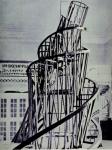
Early Soviet art: The dream was then
Why don't lefties recognize their dream now that it has become a reality? (My suspicion: they prefer the dream because it is a dream.) Two answers occur to me. One is that the underlying realities (birth, death, scarcity, illness, frustration, etc etc) haven't changed and never will, and that what lefties have really been protesting are the basic facts of life. They always assumed these problems would evaporate once avant-garde-ism was installed in power. Basic facts of life haven't changed? Well, then, the revolution hasn't really arrived.
The second is that lefties are so accustomed to thinking of their dream as a pure thing that they don't recognize it in a (necessarily messy) incarnated form. Oooooh -- money, profits, business -- nasty. That's not a revolution. But maybe there are better explanations. Do you have one?
Funny how it never seems to occur to lefties that even the revolution has to be paid for. Utopia does too. I had lunch with a friend in the Frank Gehry-designed Conde Nast lunchroom the other day, and was struck, not for the first time, by the way that Times Square represents a bringing-together of international finance, media power, avant-garde star architects, and theme park whoopee aesthetics. These elements and values are no longer in conflict. They're playing on the same team.
Not enough is made of the way the most mundane pop culture these days embodies avant-garde ideals. TV commercials and rock videos are as nonlinear and unbounded as anything Godard collaged together. What producers do with techno and rap is as far-out as anything Varese or Boulez devised. OK, the new-media artifacts are pumped-up, are determined to sell sell sell, and are set to throbbing dance beats. But something and someone's got to pay for the special effects.
Hey, maybe that's the answer: maybe lefties are holding their breath for the day when all the goodies are free.
I muse about something else as well: given that money, technology, gadgets, databases, and the mainstream media are permeated with avant-gardism these days, why would an artist choose to make a point of being avant-garde? In a free country, why not? Sure. But such a choice does seem more a matter of underlining the obvious than of cutting against the grain.
Why not choose instead some other response? This helps explain why I'm taken by the New Classicism in architecture (here), by Wynton Marsalis' impact on jazz, by Seaside (here), by poets who use rhyme and meter (here), by fiction writers who are piecing narrative back together, by the food-and-eating movement known as Slow Food (here), and by composers who are using tonality (here). I may or may not be crazy about individual works, but I find it hard not to feel sympathy for, and even moved by, the general approach. In a slip-slidey, high-key, self-vaporizing media-and-art universe that's always dematerializing beneath you, why not create an oasis of calm and quiet? Why not create experiences of solidity and depth? Why not assert the importance of traditional human values and preferences?
But perhaps this is only my temperament speaking. Then again, what's wrong with that? And, gosh, the web makes it so easy...
Best,
Michael
Knowledge Loss
Friedrich --
I was talking about books with an arty guy in his early 20s who's very bright and talented. He has a project in mind, and I was pointing out a few titles he might want to peep at to see how various problems of tone and voice can be handled. After a minute, I noticed that he had a strange, mirthful-foolish expression on his face.
“What’s up?” I asked.
“It’s about books, I was just thinking.”
“Thinking what?”
“Well, I haven’t read any of the ones you’re talking about.”
“You haven’t?”
“I haven’t read very many old books, actually.”
“But you went to a fancy, expensive, exclusive Northeastern private college. Didn’t they have you read at least a few of the great old books?”
“Well, one of the profs there told me that the canon was coming apart, and since this was probably a good thing, I didn’t have to worry about reading any of the great old books. He told me not to worry about it. So I didn’t.”
Best,
Michael
Free Reads – Oakeshott redux
Michael
I’ve been turning over the essay you recommended in your posting, Michael Oakeshott’s 1947 essay, “Rationalism in Politics." As I believe you pointed out somewhere, this “Portrait of the Rationalist as a Young Politician” describes a human type which has not limited its activities to politics. In fact, I came across a description of this human type in action while reading a story in October 10’s New York Times, “White Elephant in Vermont Reincarnated.” The individual in question is an architect, Peter Eisenman. What struck me, frankly, was the astonishing accuracy with which Oakeshott had described the life, work and mentality of a man who was only 15 at the time this essay was published.
Peter Eisenman: The Rationalist
The NY Times story depicts how a retired furniture manufacturer, John Makau, searching for a lot on which to build a summer home near Sugarbush, Vermont, spotted the unusual house, designed by Mr. Eisenman. Upon making inquiries, he discovered the house had been vacant and on the market for years. He bought it and began renovations, only learning by accident that it was rather famous in architectural circles. According to the Times:
[The abandoned home] was one of a series of 10 designs [by Peter Eisenman], of which four were built…The four houses were legendary experiments in pure theory rendered on a domestic scale with notoriously mixed results. “This was Eisenman’s first freestanding building, and it was a kickoff project,” said Joseph Rosa, the Helen Hilton Raiser curator of architecture and design at the San Francisco Museum of Modern Art. “He was helping architecture rethink itself and become self-critical [emphasis added].”
Oakeshott: To the Rationalist, nothing is of value merely because it exists (and certainly not because it has existed for many generations), familiarity has no worth, and nothing is to be left standing for want of scrutiny.
Consider the couple who commissioned House II, Florence Falk, now a psychologist in Manhattan, and Richard Falk, an emeritus professor of international law at Princeton. The Falks and Peter Eisenman started talking at a Princeton cocktail party in the late 1960s. Mr. Eisenman was then known for contentious, densely written architectural manifestoes. He had completed one project, an addition to an existing Princeton residence, which he called House I. Mr. Eisenman and Mr. Falk shared an interest in Noam Chomsky’s theories of language and mused about Mr. Eisenman called a Chomskyesque house. “I don’t know what it meant,” Mr. Falk said in a recent interview, “but it sounded good.” [Emphasis added.]
Oakeshott: [The Rationalist’s] circumstances in the modern world have made him contentious: he is the enemy of authority, of prejudice, of the merely traditional, customary or habitual.
The Falks had purchased an old dairy farm in Hardwick [Vermont] for $22,000; Mr. Eisenman suggested they tear down the house and erect a Chomskyesque successor. [Emphasis added]
Oakeshott: …[The Rationalist’s] disposition makes both destruction and creation easier for him to understand and engage in, than acceptance or reform.
Mr. Eisenman said: “I worked my tail off on this house. I drew and drew and drew.” When the Falks returned from a California sabbatical, they found a catastrophe: a house with a flat roof, impractical in an area renowned for heavy snowfalls, and numerous skylights that leaked. Worse, positioned directly under the skylights were a series of openings through the upper floor, the smallest, 27 inches square, the largest, 27 inches by 12 feet. They created a remarkable sense of openness and light, but also a hazard for the Falks’ 1-year-old son, Dimitri. Then there was the wall thing—more specifically, the lack of walls. Between what passed for bedrooms were half-walls, and even in the bathroom there was no privacy. The softest whisper was audible everywhere…Still unfinished, the house had already cost far more than the Falks’ $45,000 budget. “We couldn’t affort to finish it, we couldn’t live in it, and we couldn’t sell it,” Mr. Falk said. “Peter misled me, somewhat deliberately, about the economics.” [Emphasis added.]
Oakeshott: And this gives to [the Rationalist’s] intellectual and practical activities an almost preternatural deliberateness and self-consciousness, depriving them of any element of passivity, removing from them all sense of rhythm and continuity and dissolving them into a succession of climacterics, each to be surmounted by a tour de raison.
Mr. Eisenman sees it differently: “I don’t design houses with the nuclear family idea because I don’t believe in it as a concept . I was interested in doing architecture, not in solving the Falks’ privacy problems.” …Sitting in his Chelsea studio, the architect…said he had shown the Falks plans and models for the house and that cost overruns are an unavoidable risk when embarking on a radical new design. The fact that he has never lived in such a high-concept house (he resides in the John Adams, a Greenwhich Village 1950’s white-brick co-op) seems to him beside the point. [Emphasis added.]
Oakeshott: [The Rationalist’s] mind has no atmosphere, no changes of season and temperature; his intellectual processes, so far as possible, are insulated from all external influence and go on in the void.
…For Richard and Florence Falk, the way light moved through the house helped compensate for the staggering maintenance costs. But living in what amounted to a large sculpture held no allure for Dimitri…The unconventional look of the house branded him an outsider with local children, and the open structure made playing inside impossible, as his parents needed quiet. [Emphasis added.]
Oakeshott: And having cut himself off from the traditional knowledge of his society, and denied the value of any education more extensive than a training in a technique of analysis, he is apt to attribute to mankind a necessary inexperience in all the critical moments of life, and if he were more self-critical he might begin to wonder how the race had ever succeeded in surviving.
…[The new owner Mr. Makau’s] most significant departure [from Mr. Eisenman’s design] is the addition of a chemically treated exterior baseboard, which interrupts the flat wall but eliminates the rot caused by placing plywood directly on the concrete foundation. [Emphasis added]
Oakeshott: To patch up, to repair (that is, to do anything which requires a patient knowledge of the material), he regards as waste of time: and he always prefers the invention of a new device to making use of a current and well-tried expedient.
You know, just when you think philosophy is just a bunch of bloodless abstractions, something like this comes along and smacks you in the face. Thanks for the recommendation to read Michael Oakeshott, I’ll be doing lots more of it in the future.
Cheers,
Friedrich
October 11, 2002
Free Reads -- Amiri Baraka rereredux
Friedrich --
John Derbyshire is dryly amusing on Amiri Baraka in today's National Review Online, achieving his effects by pretending to take Baraka's poem seriously as poetry, here.
Sample passage:
Mere historical truth is of course beneath the notice of a poetic genius like Amiri Baraka. If you actually try answering some of his questions, in fact, you get into some very confusing terrain. "Who killed the most Africans?" Other Africans, without any doubt. Tribal warfare has been endemic in Africa since remote antiquity, except for the few brief decades when European colonizers suppressed it. "Who bought the slaves, who sold them?" Same answer, mostly. Every single pre-colonial African society was slave-owning, and some post-colonial ones have resumed the tradition. "Who killed Malcolm?" Some black radicals he'd fallen out with.
Best,
Michael
October 04, 2002
Amiri Baraka re-redux
Friedrich --
Thanks for pointing out the latest development in the Amiri Baraka anti-Semitic-poetry saga. It highlights, or at least gives me the chance to highlight, a dilemma lefties are forever walking into.
Here’s how it goes: Given that lefties are compulsively, dogmatically anti-authority and pro-underdog (and ignoring for the moment their strategy of being pro-underdog as a way of claiming authority) ... What happens when the underdog turns against the lefties? In this case, when the angry and (supposedly) oppressed black poet attacks the Jews? Well, what happens, as you point out, is that the lefties (in this case, the Times) come out in support of the (in this case, stupid and anti-Semitic) underdog.
Hey, let’s reward the underdog for attacking us; let’s congratulate ourselves on our noble devotion to the cause of underdogs everywhere; and let’s demonize those who would stand up for themselves in the face of attack.
It’s a pattern that shows up over and over again.
*I remember the upper-middle-class (and rich) parents who gave their rebellious, spiteful, angry hippie children credit cards.
*There was the case of a lefty woman judge in NYC who was on trial for something. Her daughter was called to testify against her, and did so devastatingly. Afterwards, the lefty judge was seen telling her daughter how well she’d done.
*These days, it’s striking to observe the Jewish intellectuals (Sontag, Chomsky) who demonstrate sympathy for Islamic fanatics.
Do lefties ever notice how often they fall into this trap? Do they even experience it as a trap? Are they proud of the way even direct assault can’t shake their “commitment”?
As someone from a smalltown Republican background, I stare at this kind of behavior utterly amazed. People in Republican small towns have their own quirks, lord knows, but I never encountered this particular kind of through-the-looking-glass, no-end-to-it neuroticism until I started moving in fancier -- more academic, leftier, more moneyed -- circles.
Did you see this kind of acting-out much before arriving at our Lousy Ivy College?
Best,
Michael
Amiri Baraka redux
Michael
The NY Times today addresses the controversy that has erupted over a poem read at a festival by the New Jersey state poet laureate Amiri Baraka (the former LeRoi Jones) entitled “Somebody Blew Up America.” In it Mr. Baraka asserted that 4000 Israeli (read Jewish) workers at the World Trade Center were told to stay home that day and laments that Israel’s Prime Minister, Ariel Sharon, stayed away. New Jersey Governor James McGreevey attempted to fire Baraka and, finding out that he can’t do that, insisted he resign; Mr. Baraka refused. From the Times’ Olympian heights it comments:
The poem’s mix of disenfranchised rage and appalling falsehood, and the controversy they have generated, are the hallmark of Mr. Baraka’s career. When you name a man known for ferocious political opinions as your poet laureate, you had better be prepared for poems that offend. But any notion that Mr. Baraka’s offensiveness should be a reason to fire or silence him is itself offensive. Mr. Baraka is not the state’s spokesman. He is a poet and he was chosen, at least partly, because of the way he seeks to give voice to the minority community. Like Mr. Baraka, that community can often be angry. Allowing him the freedom to express that anger seems part of the point of the exercise.
Apparently the Times’ logic here is that Mr. Baraka, as a member of an ‘often angry’ minority group, has been elevated above (or sunk below) such concepts as telling the truth and as such no attempt should be made by the State of New Jersey to insist on responsible behavior. Well, I’m waiting for the Times to be similarly gracious when Idaho appoints a White Supremacist poet laureate. Heck, the Aryan Nation is pretty damn angry, demonstrably a minority (even in Coeur d'Alene Idaho) and I bet those guys could string together a rhyme or two—oops, I forgot, we can’t call them that anymore. As I recall, a jury in February 2001 awarded $6.3 million (and rights to the Aryan Nation name) to a woman and her son who were attacked by Aryan Nation guards outside the white supremacist group's north Idaho headquarters. I believe the theory was that the Aryan Nation’s leader Richard Butler and the group were negligent in the selection, training and supervision of the security guards. Somehow, though, an award of $6.3 million seems kind of high for negligence; it almost looks like the Idaho jury was trying to send the group a message about their evil doctrines. Maybe somebody should consider suing the State of New Jersey for negligence in appointing Mr.Baraka.


Baraka and Butler--Brothers Under the Skin?
Cheers,
Friedrich
September 28, 2002
Free Reads -- Amiri Baraka
Friedrich --
Amiri Baraka, the African-American who is poet laureate of New Jersey, has written a poem entitled "Somebody Blew Up America" which includes these lines:
Who knew the World Trade Center was gonna get bombed
Who told 4000 Israeli workers at the Twin Towers
To stay home that day
Why did Sharon stay away?
James McGreevey, the governor of New Jersey, has asked Baraka to resign; Baraka has refused.
Matthew Purdy writes about the mess for the New York Times here.
Best,
Michael
September 21, 2002
Conservatives and Art reredux
Friedrich --
A political scientist writes in to remind us that
the two strongest grassroots constituencies for the Republican party are Protestant fundamentalists and small business people. The first have always been anti-urban and anti-intellectual, going back to the 1920s backlash against religious modernism (and earlier backlashes against what they saw as an effete, overeducated clergy). (Some of the more thoughtful religious conservatives have admitted that their movement has been hurt by a lack of intellectual candlepower). They're not a likely constituency to support art (unless you mean the "Left Behind" novels).
The second have never been much interested in art, either.
That's not to say there aren't plenty of conventional suburban Republicans who go to museums or attend concerts. And of course, it's money donated by Fortune 500 types (usually Republicans) that keep the arts afloat.
Best,
Michael